Start here: what a wave is
- A wave carries energy from one place to another without carrying matter. When a wave crosses a pond, the water moves up and down; it does not travel with the wave.
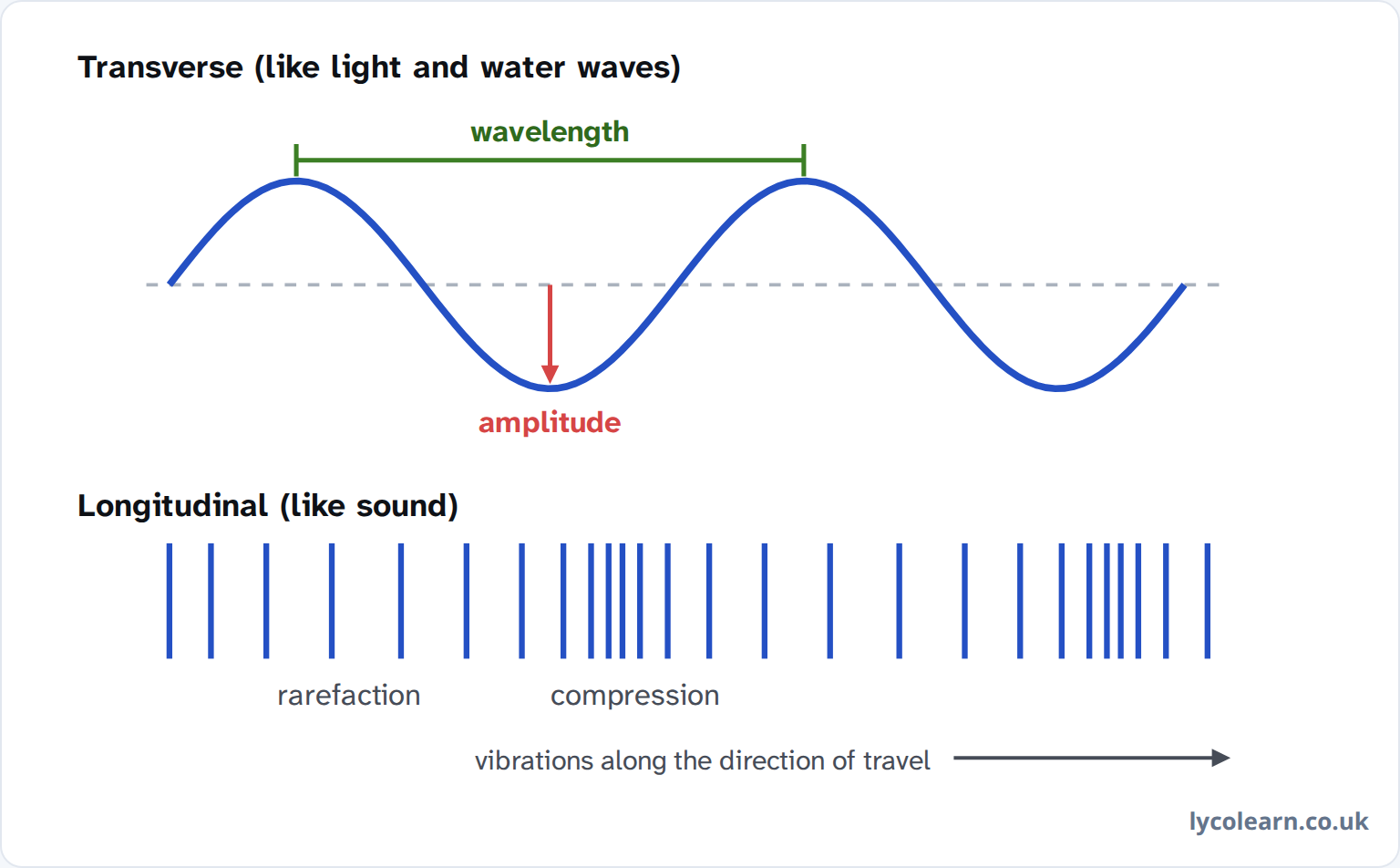
- In a transverse wave, the vibrations are at right angles to the direction the wave travels (light, water waves). In a longitudinal wave, they are along it (sound).
- Every wave has an amplitude, a wavelength, a frequency and a speed, and wave speed = frequency × wavelength.
What waves do
- Waves transfer energy from one place to another without transferring matter.
- For ripples on water and sound waves in air, it is the wave that travels, not the water or air itself. A floating object only bobs up and down as a ripple passes.
Transverse waves
- In a transverse wave, the oscillations (vibrations) are perpendicular (at right angles) to the direction of energy transfer.
- Examples: ripples on the surface of water, waves on a string, and all electromagnetic waves, such as light.
- Transverse waves have peaks (crests) and troughs.
Longitudinal waves
- In a longitudinal wave, the oscillations are parallel to the direction of energy transfer.
- They have areas of compression (particles close together) and rarefaction (particles spread out).
- Example: sound waves travelling through air. Seismic P-waves are also longitudinal.
Describing waves
- Amplitude: the maximum displacement of a point on a wave away from its undisturbed position.
- Wavelength (λ): the distance from a point on one wave to the equivalent point on the next wave, for example peak to peak.
- Frequency (f): the number of waves passing a point each second, measured in hertz (Hz).
- Period (T): the time for one complete wave to pass a point. T = 1 ÷ f.
Exam tip
- Use v = f λ, and convert units first, such as kHz to Hz.
- Show amplitude and wavelength clearly on a diagram: amplitude goes from the middle to a peak, and wavelength goes from one point to the same point on the next wave.
Common mistakes
- Measuring amplitude from peak to trough.
- Saying waves carry the material along. They transfer energy, not matter.
Key terms
- Wave
- A way of transferring energy without transferring matter.
- Transverse wave
- A wave whose oscillations are perpendicular to the direction of energy transfer.
- Longitudinal wave
- A wave whose oscillations are parallel to the direction of energy transfer.
- Compression
- A region of a longitudinal wave where the particles are close together.
- Rarefaction
- A region of a longitudinal wave where the particles are spread out.
- Amplitude
- The maximum displacement of a point on a wave from its undisturbed position.
- Wavelength
- The distance from one point on a wave to the same point on the next wave.
- Frequency
- The number of waves passing a point each second, in hertz.
- Period
- The time taken for one complete wave to pass a point.
Quick questions on Transverse and longitudinal waves
- What do waves transfer?
- Energy: The medium itself does not travel with the wave.
- In a transverse wave, how are the oscillations arranged?
- Perpendicular to the direction of energy transfer: Like a wave on a string.
- Which of these is a longitudinal wave?
- Sound in air: Sound has compressions and rarefactions.
- What is a compression?
- A region where particles are close together: Rarefactions are where particles are spread out.
- What is amplitude?
- The maximum displacement from the undisturbed position: Bigger amplitude means more energy.
- What is wavelength?
- The distance from a point on one wave to the same point on the next: For example, peak to peak.
- What is the unit of frequency?
- Hertz (Hz): 1 Hz = 1 wave per second.
- A wave has a frequency of 50 Hz. What is its period?
- 0.02 s: T = 1 ÷ 50 = 0.02 s.
- A duck floats on a pond as ripples pass. What happens to the duck?
- It bobs up and down but doesn't move along with the waves: The water doesn't travel with the wave.
- Which type of wave are all electromagnetic waves?
- Transverse: Light is a transverse wave.
Transverse and longitudinal waves: exam-style questions and mark schemes
Which statement describes a longitudinal wave? [1 mark]
Answer: The oscillations are parallel to the direction of energy transfer
A wave has a period of 0.25 s. Calculate its frequency. [2 marks]
- f = 1 ÷ T = 1 ÷ 0.25 (1)
- = 4 Hz (1)
Describe the difference between transverse and longitudinal waves, with an example of each. [3 marks]
- Transverse: oscillations perpendicular to the direction of energy transfer (1)
- Longitudinal: oscillations parallel to the direction of energy transfer, with compressions and rarefactions (1)
- Examples: transverse, such as light or water ripples; longitudinal, such as sound in air (1)
Describe evidence that when a sound wave travels through air, the air itself does not travel with it. [2 marks]
- The air particles vibrate back and forth about fixed positions (1)
- A candle flame in front of a loudspeaker flickers back and forth but isn't blown away (1)
Which of these is a longitudinal wave? [1 mark]
Answer: Sound in air
Describe the difference between transverse and longitudinal waves. [2 marks]
- transverse: oscillations perpendicular to the direction of energy transfer (1)
- longitudinal: oscillations parallel to the direction of energy transfer (1)
Explain how the study of P-waves and S-waves provides evidence for the structure of the Earth. [6 marks]
- earthquakes produce seismic waves detected by seismometers around the world
- P-waves are longitudinal and travel through solids and liquids
- S-waves are transverse and cannot travel through liquids
- no S-waves are detected on the far side of the Earth (S-wave shadow zone)
- so part of the core (the outer core) must be liquid
- P-waves change speed in different materials and refract, so their paths curve
- P-waves refract at the core boundary, producing P-wave shadow zones, giving the size of the core
- this gives evidence about parts of the Earth that cannot be observed directly
How to answer them: exam technique and command words.
More on Transverse and longitudinal waves
Transverse and longitudinal waves: questions and answers
- A duck floats on a pond as ripples pass. What happens to the duck?
- It bobs up and down but doesn't move along with the waves. The water doesn't travel with the wave.
- Which type of wave are all electromagnetic waves?
- Light is a transverse wave.