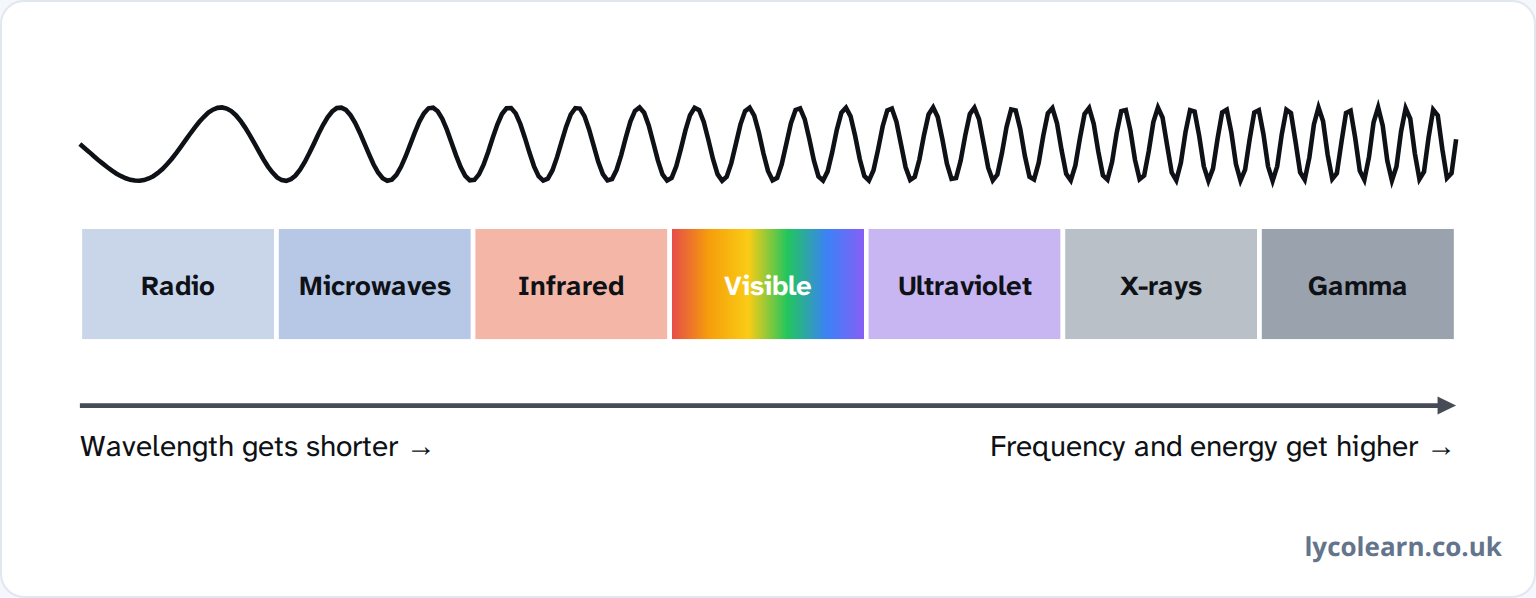
The electromagnetic spectrum
- Electromagnetic waves are transverse waves that transfer energy from the source to an absorber.
- They form a continuous spectrum, and all types travel at the same speed through a vacuum or air: 3 × 10⁸ m/s.
- In order of increasing frequency (decreasing wavelength): radio waves, microwaves, infrared, visible light (red to violet), ultraviolet, X-rays, gamma rays.
- Our eyes only detect visible light, a very limited range of the spectrum.
How EM waves are made and absorbed
- Different wavelengths are reflected, refracted, absorbed or transmitted differently by different substances and surfaces.
- (Higher) Radio waves can be produced by oscillations in electrical circuits. When radio waves are absorbed, they can create an alternating current with the same frequency, which is how aerials work.
- Changes in atoms and in their nuclei can generate or absorb EM waves. Gamma rays come from changes in the nucleus.
Uses
- Radio waves: television and radio broadcasting. Microwaves: satellite communications and cooking food.
- Infrared: electrical heaters, cooking food and infrared cameras. Visible light: fibre optic communications.
- Ultraviolet: energy-efficient lamps and sun tanning. X-rays and gamma rays: medical imaging and treatments.
- (Higher) Each use suits the wave's properties: for example, X-rays pass through soft tissue but are absorbed by bone.
Dangers
- Ultraviolet, X-rays and gamma rays can have hazardous effects on human body tissue. The effects depend on the type of radiation and the size of the dose (measured in sieverts).
- Ultraviolet can make skin age prematurely and increase the risk of skin cancer.
- X-rays and gamma rays are ionising radiation that can cause mutation of genes and cancer.
Required practical: infrared radiation
- Use a Leslie cube: a hollow cube with four different surfaces (matt black, shiny black, matt white, shiny silver). Fill it with hot water.
- Measure the infrared radiated from each surface with an infrared detector at the same distance.
- Matt black surfaces are the best emitters (and absorbers) of infrared; shiny silver surfaces are the worst, and the best reflectors.
Key terms
- Electromagnetic spectrum
- The continuous range of EM waves from radio waves to gamma rays.
- Radio waves
- EM waves with the longest wavelength, used for broadcasting.
- Microwaves
- EM waves used for satellite communication and cooking.
- Infrared
- EM radiation emitted by warm objects, used in heaters and thermal cameras.
- Ultraviolet
- EM radiation that can damage skin and cause skin cancer.
- X-rays
- Ionising EM waves used in medical imaging.
- Gamma rays
- The highest-frequency, ionising EM waves, from the nucleus.
- Ionising radiation
- Radiation that can remove electrons from atoms, damaging cells.
- Leslie cube
- A cube with differently finished faces used to compare infrared emission.
Quick questions on The electromagnetic spectrum
- Which EM wave has the longest wavelength?
- Radio waves: Radio waves have the lowest frequency.
- Which EM wave has the highest frequency?
- Gamma rays: Gamma rays have the shortest wavelength.
- What do all EM waves have in common?
- They travel at the same speed in a vacuum: They travel at 3 × 10⁸ m/s.
- Which EM wave is used for satellite communications?
- Microwaves: Microwaves pass through the atmosphere.
- Which EM wave is used in fibre optic communications?
- Visible light: Infrared is also used.
- Which EM wave can cause skin cancer?
- Ultraviolet: UV also makes skin age prematurely.
- Why are X-rays used to image bones?
- They pass through soft tissue but are absorbed by bone: Bones show up as shadows.
- Which colour of visible light has the longest wavelength?
- Red: Violet has the shortest wavelength.
- Which surface is the best emitter of infrared?
- Matt black: Matt black surfaces also absorb infrared best.
- What is the order of increasing frequency?
- Radio, microwave, infrared, visible, UV, X-ray, gamma: Wavelength decreases in the same order.
- How can radio waves produce an alternating current?
- When absorbed by an aerial, they make charges oscillate: The current has the same frequency as the radio wave.
The electromagnetic spectrum: exam-style questions and mark schemes
Which part of the electromagnetic spectrum is used in electrical heaters? [1 mark]
Answer: Infrared
Explain why X-rays and gamma rays are dangerous to people. [2 marks]
- They are ionising radiation (1)
- They can cause mutations in genes, which can lead to cancer (1)
Give three uses of electromagnetic waves, naming the type of wave for each. [3 marks]
- Radio waves for broadcasting television and radio (1)
- Microwaves for satellite communications or cooking (1)
- Infrared for heaters, cameras or cooking; or X-rays for medical imaging (1)
Describe how to use a Leslie cube to investigate how the type of surface affects the infrared radiation emitted. [6 marks]
- Fill the Leslie cube with hot water from a kettle (1)
- Place an infrared detector a fixed distance from one face (1)
- Record the reading (1)
- Repeat for each face at the same distance (1)
- Do it quickly so the water temperature doesn't change much (1)
- Compare: matt black emits the most infrared; shiny silver emits the least (1)
Which type of electromagnetic wave has the longest wavelength? [1 mark]
Answer: Radio waves
A ray of light enters a glass block at an angle to the normal. Describe and explain what happens to the ray. [3 marks]
- it refracts / changes direction (1)
- bends towards the normal (1)
- because it slows down in glass (1)
Explain why X-rays are suitable for medical imaging of bones, and why microwaves are suitable for satellite communication. Include any risks. [6 marks]
- X-rays pass through soft tissue but are absorbed by bone
- so bones show up on the image / photographic film or detector
- X-rays are ionising and can cause mutations and cancer, so the dose is kept low
- radiographers use shielding and stand behind screens / leave the room
- microwaves pass through the atmosphere (and clouds) without being absorbed
- so they can travel to and from satellites in space
- microwaves used for communication are low power and non-ionising
How to answer them: exam technique and command words.
The electromagnetic spectrum: questions and answers
- Which surface is the best emitter of infrared?
- Matt black surfaces also absorb infrared best.
- What is the order of increasing frequency?
- Radio, microwave, infrared, visible, UV, X-ray, gamma. Wavelength decreases in the same order.
- How can radio waves produce an alternating current?
- When absorbed by an aerial, they make charges oscillate. The current has the same frequency as the radio wave.