Start here: how your body responds
- Your body has to respond to changes, called stimuli: a hot plate, a loud noise, a ball coming towards you.
- Receptors detect the change, the central nervous system (your brain and spinal cord) decides what to do, and effectors (muscles or glands) carry out the response.
- Messages travel along nerve cells (neurones) as electrical impulses, which is why nervous responses are so fast.
Homeostasis
- Homeostasis is the regulation of the internal conditions of a cell or organism to keep them at the best levels for function, whatever the changes inside or outside the body.
- In humans it controls blood glucose concentration, body temperature and water levels.
- Control systems have receptors (which detect stimuli), coordination centres such as the brain, spinal cord and pancreas (which process the information) and effectors, muscles or glands (which bring about responses).
The nervous system
- The nervous system lets humans react to their surroundings and coordinate their behaviour.
- Information travels as electrical impulses along neurones.
- The central nervous system (CNS) is the brain and spinal cord.
- Stimulus → receptor → coordinator → effector → response.
Neurones and synapses
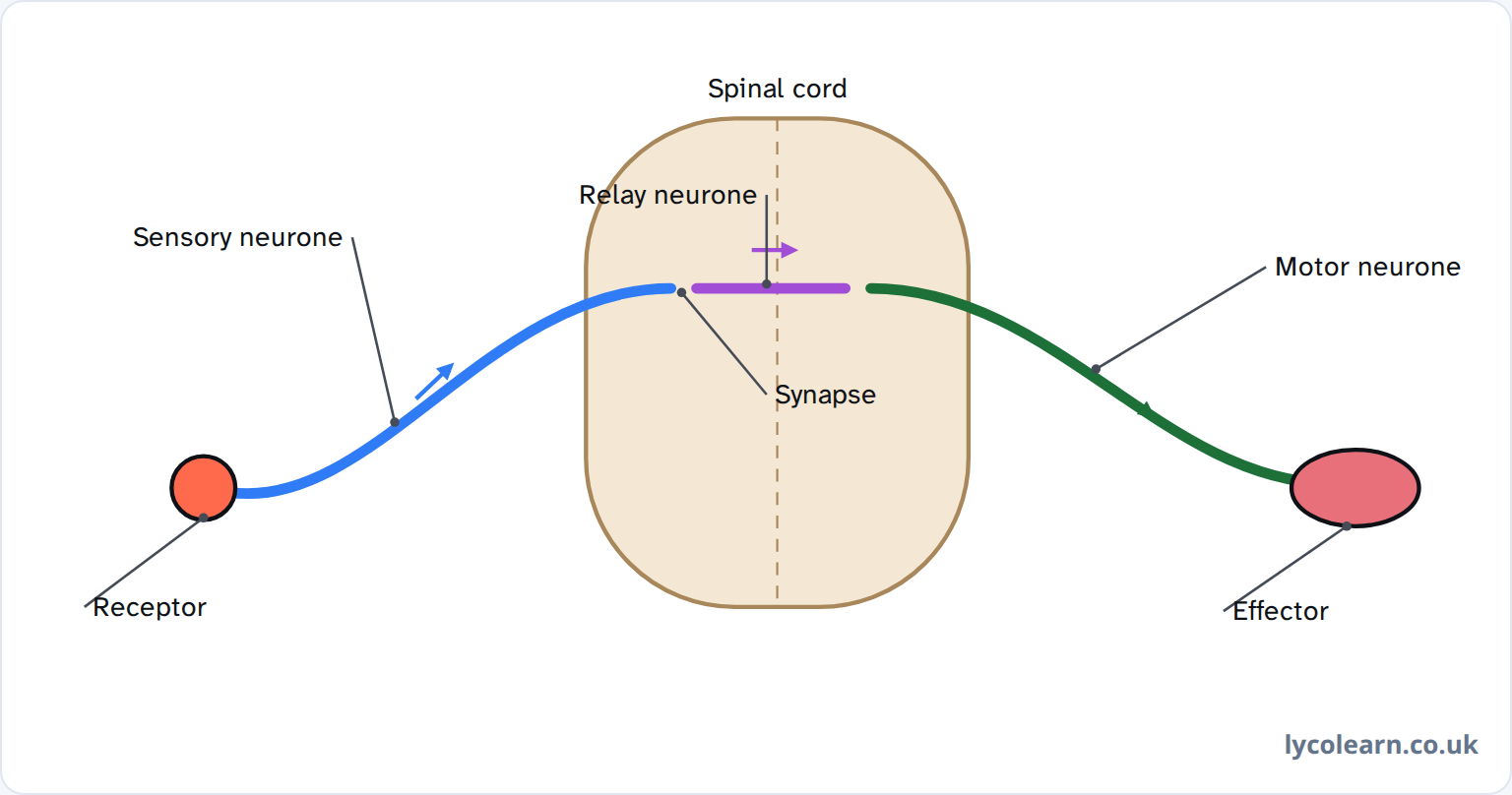
- Sensory neurones carry impulses from receptors to the CNS. Relay neurones carry impulses within the CNS. Motor neurones carry impulses from the CNS to effectors.
- A synapse is a tiny gap between two neurones. When an impulse arrives, a chemical is released that diffuses across the gap and starts an impulse in the next neurone.
Reflexes
- Reflex actions are automatic and rapid; they do not involve the conscious part of the brain. They protect the body from harm.
- Reflex arc: receptor → sensory neurone → relay neurone (in the spinal cord) → motor neurone → effector.
- Example: touching a hot object makes a muscle contract to pull the hand away.
Required practical: reaction time
- One person drops a ruler between the other person's finger and thumb without warning; they catch it as fast as possible.
- Record the distance the ruler falls; a shorter distance means a faster reaction. Convert to reaction time using a table.
- Repeat several times and find the mean. Test the effect of a factor such as caffeine, keeping everything else the same.
Exam tip
- Learn the reflex arc in order: stimulus, receptor, sensory neurone, relay neurone, motor neurone, effector, response.
- At a synapse, say that a chemical diffuses across the gap.
Common mistakes
- Saying a reflex goes through the conscious part of the brain.
- Saying an electrical impulse jumps across a synapse.
- Writing 'messages' instead of 'electrical impulses'.
Key terms
- Homeostasis
- Keeping the internal conditions of the body at the best levels for function.
- Stimulus
- A change in the environment that is detected by a receptor.
- Receptor
- A cell that detects a stimulus.
- Effector
- A muscle or gland that brings about a response.
- Central nervous system
- The brain and spinal cord.
- Sensory neurone
- A neurone that carries impulses from receptors to the CNS.
- Relay neurone
- A neurone that carries impulses within the CNS.
- Motor neurone
- A neurone that carries impulses from the CNS to effectors.
- Synapse
- The gap between two neurones, crossed by a chemical.
- Reflex action
- A fast, automatic response that does not involve the conscious brain.
Quick questions on The nervous system and reflexes
- What is homeostasis?
- Keeping internal conditions at the best levels for function: It controls blood glucose, temperature and water levels.
- What makes up the central nervous system?
- The brain and spinal cord: The CNS is the coordination centre.
- What is an effector?
- A muscle or gland that responds to an impulse: Muscles contract and glands release hormones.
- What carries impulses from receptors to the CNS?
- Sensory neurones: Sensory neurones bring information into the CNS.
- What crosses a synapse?
- A chemical: A chemical diffuses across the gap.
- Why are reflex actions fast?
- They do not involve the conscious part of the brain: The response is automatic.
- What is the correct order in a reflex arc?
- Receptor, sensory neurone, relay neurone, motor neurone, effector: The impulse travels from receptor to effector.
- Where are relay neurones found in a reflex arc?
- In the spinal cord: Relay neurones connect sensory and motor neurones in the CNS.
- In the ruler-drop test, what does a shorter catching distance show?
- A faster reaction time: The ruler had less time to fall.
- Which of these is a coordination centre?
- The pancreas: The brain, spinal cord and pancreas receive and process information.
- What is a receptor?
- A cell that detects a stimulus: For example, light receptors in the eye.
The nervous system and reflexes: exam-style questions and mark schemes
Which type of neurone carries impulses to an effector? [1 mark]
Answer: Motor neurone
Explain why reflex actions are important. [2 marks]
- They are fast and automatic (1)
- So they protect the body from harm, for example pulling a hand away from something hot (1)
Describe how an impulse passes across a synapse. [3 marks]
- The impulse arrives at the end of the first neurone (1)
- A chemical is released and diffuses across the gap (1)
- It binds to the next neurone and starts a new impulse (1)
Describe how you could use a ruler to investigate whether caffeine affects reaction time. [6 marks]
- One person drops a ruler, without warning, between the other's finger and thumb (1)
- The other person catches it as quickly as possible (1)
- Record the distance fallen and convert it to reaction time (1)
- Repeat several times and calculate a mean (1)
- Repeat after drinking a caffeinated drink (1)
- Control variables such as the same hand, the same starting position and the same person dropping (1)
Which of these is part of the central nervous system? [1 mark]
Answer: Spinal cord
Describe the path taken by a nerve impulse in the reflex arc when a person touches a hot object. [4 marks]
- (stimulus detected by) receptor in the skin (1)
- impulse travels along a sensory neurone to the CNS / spinal cord (1)
- (across a synapse) to a relay neurone (1)
- (across a synapse) to a motor neurone to the effector / muscle, which contracts (1)
Explain why reflex actions are faster than responses that involve conscious thought. [4 marks]
- reflex arcs do not involve the conscious part of the brain (1)
- impulse passes through fewer neurones / synapses (1)
- (synapses slow impulses down because) chemicals must diffuse across them (1)
- so the time between stimulus and response is shorter (1)
How to answer them: exam technique and command words.
The nervous system and reflexes: questions and answers
- In the ruler-drop test, what does a shorter catching distance show?
- A faster reaction time. The ruler had less time to fall.
- Which of these is a coordination centre?
- The pancreas. The brain, spinal cord and pancreas receive and process information.
- What is a receptor?
- A cell that detects a stimulus. For example, light receptors in the eye.