Start here: the body’s transport system
- Every cell needs oxygen and glucose, and has to get rid of carbon dioxide. Blood carries them all round the body.
- The heart is a pump that pushes blood through blood vessels: arteries carry blood away from the heart, veins bring it back, and tiny capillaries pass close to every cell.
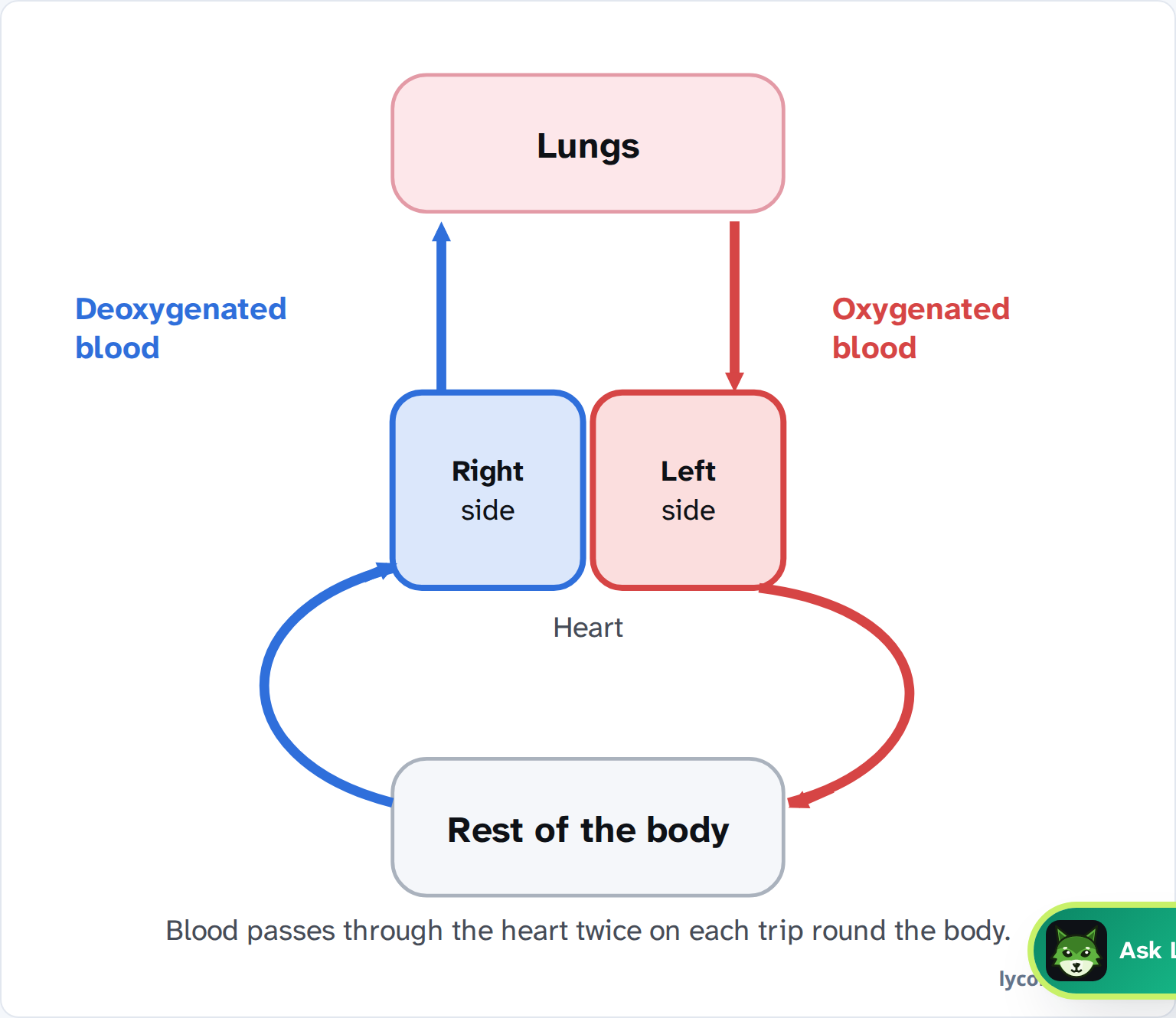
- Humans have a double circulation: blood goes through the heart twice on each full trip, once to the lungs to pick up oxygen and once round the body.
The heart and double circulation
- The heart is an organ that pumps blood around the body in a double circulatory system.
- The right ventricle pumps deoxygenated blood to the lungs, where it picks up oxygen. The left ventricle pumps oxygenated blood around the rest of the body.
- The heart has four chambers: two atria at the top receive blood; two ventricles at the bottom pump it out. Valves stop blood flowing backwards.
- The left ventricle has a thicker muscular wall because it pumps blood all round the body.
- The heart muscle gets its own oxygen from the coronary arteries.
- The natural resting heart rate is controlled by a group of pacemaker cells in the right atrium. An artificial pacemaker can correct an irregular heart rate.
Blood vessels
- Arteries carry blood away from the heart at high pressure. They have thick, muscular, elastic walls.
- Veins carry blood back to the heart at low pressure. They have thinner walls, a wide lumen and valves to stop backflow.
- Capillaries are tiny vessels with walls one cell thick, so substances diffuse easily between the blood and body cells.
- Rate of blood flow = volume of blood ÷ time.
Blood
- Blood is a tissue made of plasma, red blood cells, white blood cells and platelets.
- Plasma carries blood cells, dissolved glucose, amino acids, carbon dioxide, urea, hormones and proteins.
- Red blood cells carry oxygen using haemoglobin. They are biconcave discs with no nucleus, giving more room for haemoglobin and a large surface area.
- White blood cells defend against pathogens. Platelets are cell fragments that help blood to clot.
The lungs
- Air passes down the trachea, into two bronchi, then into bronchioles, ending in millions of alveoli.
- Oxygen diffuses from the alveoli into the blood in the capillaries, and carbon dioxide diffuses the other way.
- Alveoli are adapted with a huge surface area, thin walls, a moist lining and a rich blood supply.
Coronary heart disease
- In coronary heart disease, layers of fatty material build up inside the coronary arteries, narrowing them and reducing the flow of oxygen to the heart muscle.
- Stents are tubes that hold arteries open. Statins are drugs that lower blood cholesterol, slowing the build-up of fatty material.
- Faulty valves can be replaced with biological or mechanical valves. Heart failure may be treated with a donor heart or an artificial heart.
- Each treatment has risks and side effects; for example, surgery carries a risk of infection and statins may cause side effects.
Exam tip
- Learn the route: vena cava, right atrium, right ventricle, pulmonary artery, lungs, pulmonary vein, left atrium, left ventricle, aorta.
- Link structure to job: arteries have thick muscular walls for high pressure, veins have valves, capillaries are one cell thick for fast diffusion.
Common mistakes
- Mixing up left and right: a heart diagram is drawn as if it's facing you.
- Saying all arteries carry oxygenated blood. The pulmonary artery doesn't.
- Saying the left ventricle's wall is thicker because it holds more blood. It pumps at a higher pressure, around the whole body.
Key terms
- Double circulatory system
- A system in which blood passes through the heart twice in each full circuit: once to the lungs and once to the body.
- Atrium
- An upper chamber of the heart that receives blood.
- Ventricle
- A lower chamber of the heart that pumps blood out.
- Artery
- A blood vessel with thick, muscular walls that carries blood away from the heart.
- Vein
- A blood vessel with thin walls and valves that carries blood back to the heart.
- Capillary
- A tiny blood vessel with walls one cell thick where substances are exchanged.
- Coronary arteries
- The arteries that supply the heart muscle with oxygenated blood.
- Haemoglobin
- The red protein in red blood cells that carries oxygen.
- Plasma
- The pale yellow liquid part of blood that carries cells and dissolved substances.
- Platelets
- Cell fragments that help the blood to clot.
- Stent
- A mesh tube put inside an artery to keep it open.
- Statin
- A drug that reduces the level of cholesterol in the blood.
Quick questions on The heart, blood and blood vessels
- Which chamber pumps blood to the lungs?
- Right ventricle: The right side of the heart pumps deoxygenated blood to the lungs.
- Why does the left ventricle have a thicker wall than the right?
- It pumps blood all around the body: More muscle is needed to pump blood at high pressure around the body.
- What do the coronary arteries supply?
- The heart muscle: Coronary arteries carry oxygenated blood to the heart muscle.
- Where are the pacemaker cells that control the resting heart rate?
- In the right atrium: A group of cells in the right atrium acts as the natural pacemaker.
- Which blood vessels have valves?
- Veins: Veins carry low-pressure blood, so valves stop it flowing backwards.
- Why are capillary walls one cell thick?
- So substances can diffuse quickly between blood and cells: A short diffusion distance speeds up exchange.
- What does haemoglobin carry?
- Oxygen: Haemoglobin in red blood cells binds oxygen.
- Why do red blood cells have no nucleus?
- To make more room for haemoglobin: No nucleus means more space to carry oxygen.
- What do platelets do?
- Help blood to clot: Platelets help seal wounds.
- 150 ml of blood passes through an artery in 5 minutes. What is the rate of blood flow?
- 30 ml/min: Rate = volume ÷ time = 150 ÷ 5 = 30 ml/min.
- What is a stent used for?
- Keeping a narrowed coronary artery open: A stent holds the artery open so blood can flow.
- In which part of the lungs does gas exchange happen?
- Alveoli: Oxygen and carbon dioxide diffuse across the thin alveolar walls.
The heart, blood and blood vessels: exam-style questions and mark schemes
Which blood vessel carries blood at the highest pressure? [1 mark]
Answer: Artery
Describe how the structure of a vein is related to its function. [3 marks]
- Veins carry blood back to the heart at low pressure (1)
- They have thin walls because the pressure is low (1)
- They have valves to stop blood flowing backwards, and a wide lumen (1)
A person's heart pumps 5600 ml of blood in 80 seconds. Calculate the rate of blood flow in ml per second. [2 marks]
- 5600 ÷ 80 (1)
- = 70 ml/s (1)
Coronary heart disease can be treated with stents or with statins. Evaluate these two treatments. [6 marks]
- Stents hold narrowed arteries open so blood can reach the heart muscle (1)
- Stents work immediately and the patient recovers quickly (1)
- Stents need surgery, with risks such as infection or blood clots, and the artery can narrow again (1)
- Statins lower blood cholesterol, slowing the build-up of fatty material (1)
- Statins must be taken every day, take time to work and can have side effects (1)
- A justified conclusion comparing the two (1)
Which blood vessel carries oxygenated blood from the lungs to the heart? [1 mark]
Answer: Pulmonary vein
Explain why the wall of the left ventricle is thicker than the wall of the right ventricle. [3 marks]
- left ventricle pumps blood to the whole body / right pumps only to the lungs (1)
- more muscle so contracts more strongly (1)
- to pump blood at higher pressure (over a longer distance) (1)
Explain how the lungs are adapted for efficient gas exchange. [6 marks]
- millions of alveoli, giving a large surface area
- so more oxygen / carbon dioxide can diffuse at the same time
- alveolus walls (and capillary walls) one cell thick / thin
- short diffusion distance so diffusion is faster
- good blood supply / network of capillaries
- blood carries oxygen away / brings carbon dioxide, maintaining a steep concentration gradient
- ventilation brings in fresh air, keeping oxygen concentration in the alveoli high
- moist lining so gases dissolve
How to answer them: exam technique and command words.
More on The heart, blood and blood vessels
The heart, blood and blood vessels: questions and answers
- What do platelets do?
- Help blood to clot. Platelets help seal wounds.
- 150 ml of blood passes through an artery in 5 minutes. What is the rate of blood flow?
- Rate = volume ÷ time = 150 ÷ 5 = 30 ml/min.
- What is a stent used for?
- Keeping a narrowed coronary artery open. A stent holds the artery open so blood can flow.