The brain
- The brain controls complex behaviour. It is made of billions of interconnected neurones and has different regions for different jobs.
- The cerebral cortex is responsible for consciousness, intelligence, memory and language.
- The cerebellum coordinates muscle activity and balance.
- The medulla controls unconscious activities such as heart rate and breathing.
- Scientists study the brain using patients with brain damage, electrical stimulation of different areas and MRI scans. Treating brain damage and disease is difficult because the brain is complex and delicate.
Parts of the eye
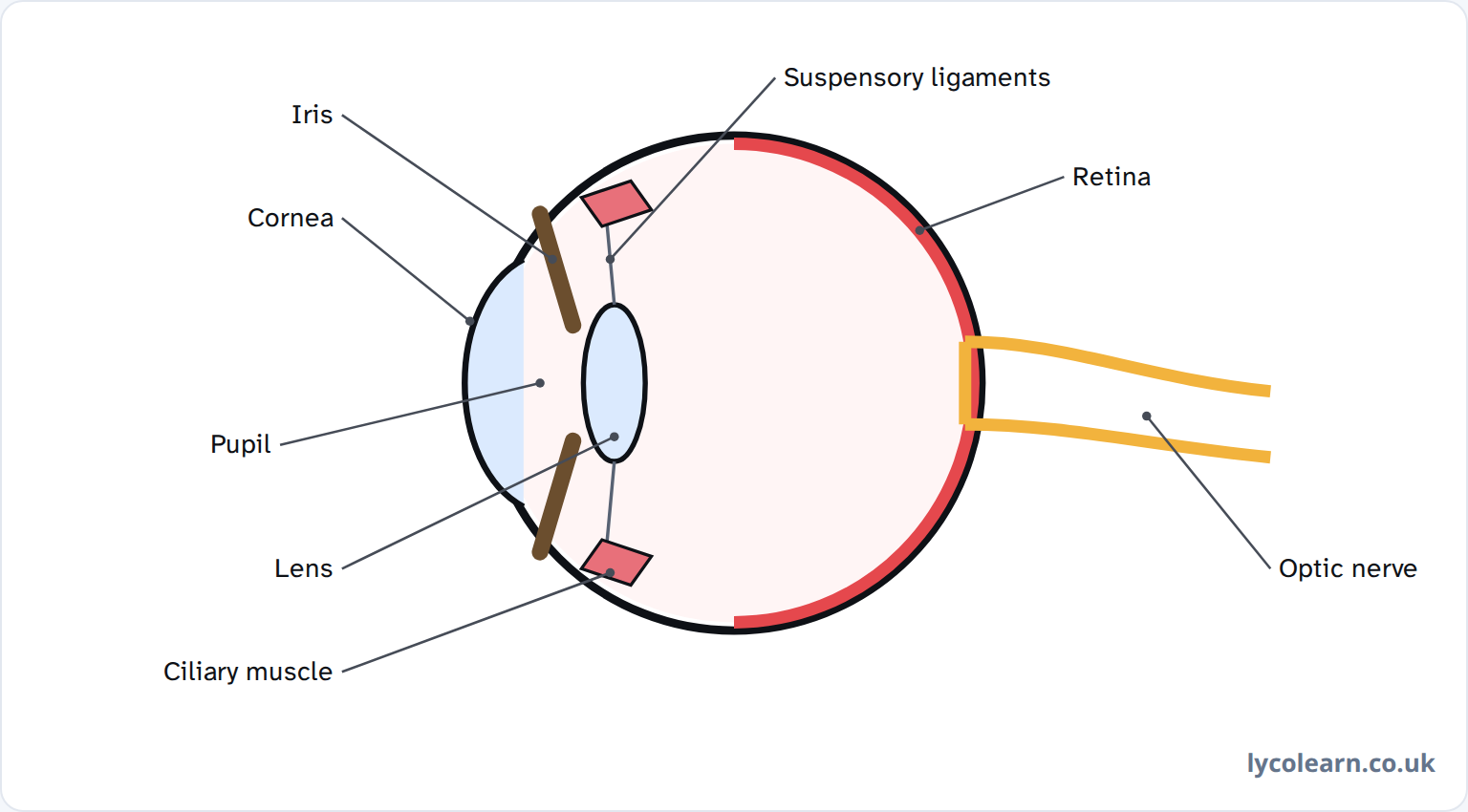
- The retina contains receptor cells sensitive to light intensity and colour.
- The optic nerve carries impulses from the retina to the brain.
- The sclera is the tough white outer layer; the cornea is the transparent front part that refracts light into the eye.
- The iris controls the size of the pupil and so how much light enters the eye.
- Ciliary muscles and suspensory ligaments change the shape of the lens to focus light on the retina.
Accommodation
- To focus on a near object, the ciliary muscles contract, the suspensory ligaments loosen, and the lens becomes thicker so it refracts light more.
- To focus on a distant object, the ciliary muscles relax, the suspensory ligaments are pulled tight, and the lens is pulled thin so it refracts light less.
Vision problems
- Myopia (short-sightedness): distant objects look blurred because light is focused in front of the retina. It is corrected with concave lenses.
- Hyperopia (long-sightedness): near objects look blurred because light is focused behind the retina. It is corrected with convex lenses.
- Treatments include glasses, hard and soft contact lenses, laser surgery to change the shape of the cornea, and replacing the lens.
Key terms
- Cerebral cortex
- The part of the brain responsible for consciousness, intelligence, memory and language.
- Cerebellum
- The part of the brain that coordinates muscle activity.
- Medulla
- The part of the brain that controls unconscious activities such as breathing and heart rate.
- Retina
- The layer at the back of the eye containing light-sensitive receptor cells.
- Cornea
- The transparent front of the eye that refracts light.
- Iris
- The coloured ring of muscle that controls the size of the pupil.
- Ciliary muscles
- Muscles that change the shape of the lens.
- Suspensory ligaments
- Fibres that connect the ciliary muscles to the lens.
- Accommodation
- Changing the shape of the lens to focus on near or distant objects.
- Myopia
- Short-sightedness, corrected with a concave lens.
- Hyperopia
- Long-sightedness, corrected with a convex lens.
Quick questions on The brain and the eye
- Which part of the brain controls heart rate and breathing?
- Medulla: The medulla controls unconscious activities.
- Which part of the brain coordinates muscle activity?
- Cerebellum: The cerebellum controls balance and coordination.
- Which part of the brain is responsible for memory and language?
- Cerebral cortex: The cerebral cortex is the wrinkled outer layer.
- What does the iris do?
- Controls the size of the pupil: This controls how much light enters.
- What happens to the lens when you look at a near object?
- It becomes thicker: A thicker lens refracts light more.
- When looking at a distant object, what do the ciliary muscles do?
- Relax: Relaxed ciliary muscles let the ligaments pull the lens thin.
- What type of lens corrects short-sightedness (myopia)?
- Concave lens: A concave lens spreads light out so it focuses on the retina.
- Where is light focused in a long-sighted (hyperopic) eye?
- Behind the retina: A convex lens is used to correct it.
- What does the optic nerve do?
- Carries impulses from the retina to the brain: The brain turns the impulses into an image.
- Which part of the eye refracts light and is transparent?
- Cornea: Most refraction happens at the cornea.
- How do scientists study how the brain works?
- Using MRI scans, electrical stimulation and patients with brain damage: These methods link brain areas to their functions.
The brain and the eye: exam-style questions and mark schemes
Which part of the eye contains light-sensitive receptor cells? [1 mark]
Answer: Retina
Give two reasons why it is difficult to treat brain damage. [2 marks]
- The brain is very complex, so it is hard to know which part is damaged (1)
- Brain tissue is delicate and treatment risks damaging other areas (1)
Describe how the eye changes to focus on a near object. [4 marks]
- The ciliary muscles contract (1)
- The suspensory ligaments loosen (1)
- The lens becomes thicker and more rounded (1)
- So light is refracted more and focused on the retina (1)
Explain what causes short-sightedness and how it can be corrected. [3 marks]
- Light from distant objects is focused in front of the retina (1)
- Because the eyeball is too long or the lens is too thick or strong (1)
- Corrected with a concave lens (or laser surgery or contact lenses) (1)
Which part of the brain controls heartbeat and breathing rate? [1 mark]
Answer: Medulla
Describe how the eye focuses on a near object. [3 marks]
- ciliary muscles contract (1)
- suspensory ligaments loosen / slacken (1)
- lens becomes thicker / more rounded and refracts light more (strongly) (1)
A person has hyperopia (long-sightedness). Explain why they cannot see near objects clearly and how a spectacle lens corrects this. [4 marks]
- light from near objects focuses behind the retina (1)
- because the lens is too flat / weak or the eyeball is too short (1)
- a convex / converging lens is used (1)
- which refracts light (more) so it focuses on the retina (1)
How to answer them: exam technique and command words.
The brain and the eye: questions and answers
- What does the optic nerve do?
- Carries impulses from the retina to the brain. The brain turns the impulses into an image.
- Which part of the eye refracts light and is transparent?
- Most refraction happens at the cornea.
- How do scientists study how the brain works?
- Using MRI scans, electrical stimulation and patients with brain damage. These methods link brain areas to their functions.