Start here: unstable nuclei
- Some nuclei are unstable: they have too many neutrons, or are too big. They give out radiation to become more stable. This is radioactive decay.
- Decay is random: you cannot say when one nucleus will decay, but with billions of them you can predict how quickly the activity falls.
- Activity is the number of nuclei that decay each second, measured in becquerels (Bq). The half-life is the time it takes for the activity to halve.
Radioactive decay
- Some atomic nuclei are unstable. The nucleus gives out radiation as it changes to become more stable. This is radioactive decay, and it is a random process.
- Activity is the rate at which a source of unstable nuclei decays, measured in becquerels (Bq). 1 Bq = 1 decay per second.
- Count rate is the number of decays recorded each second by a detector, such as a Geiger–Müller tube.
Types of nuclear radiation
- Alpha particle (α): two protons and two neutrons, the same as a helium nucleus.
- Beta particle (β): a high-speed electron ejected from the nucleus as a neutron turns into a proton.
- Gamma ray (γ): electromagnetic radiation from the nucleus.
- A nucleus can also emit a neutron.
Properties
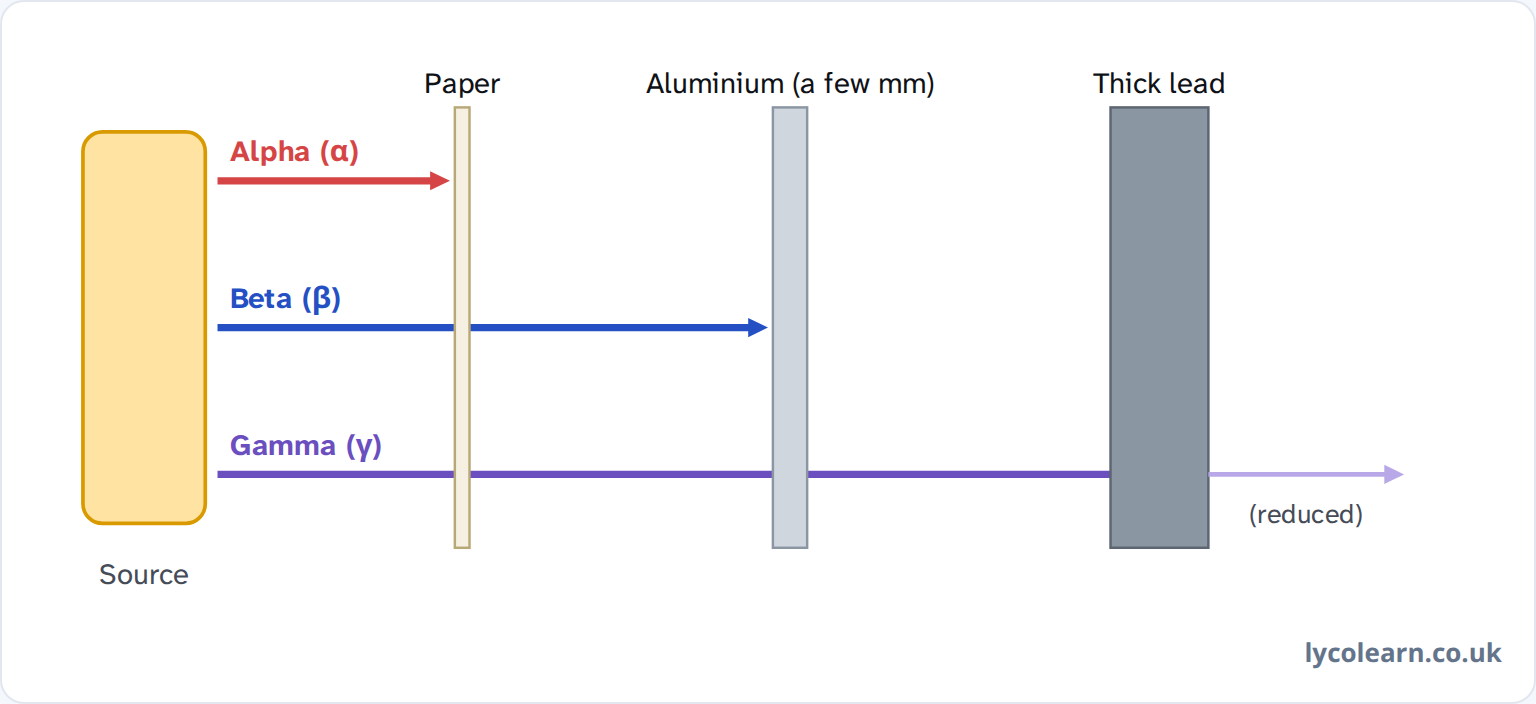
- Alpha: strongly ionising; travels only a few centimetres in air; stopped by a sheet of paper or skin.
- Beta: moderately ionising; travels about a metre in air; stopped by a few millimetres of aluminium.
- Gamma: weakly ionising; travels a very long distance in air; reduced by several centimetres of lead or a thick layer of concrete.
Nuclear equations
- Alpha decay: the mass number goes down by 4 and the atomic number by 2. Example: ²¹⁹₈₆Rn → ²¹⁵₈₄Po + ⁴₂He.
- Beta decay: the mass number stays the same and the atomic number goes up by 1. Example: ¹⁴₆C → ¹⁴₇N + ⁰₋₁e.
- Gamma emission does not change the mass or the charge of the nucleus.
- In every equation, the mass numbers and the atomic numbers must balance on both sides.
Exam tip
- Balance nuclear equations at the top and the bottom.
- To read a half-life from a graph, find the time the count rate takes to halve. Show the lines you've drawn.
Common mistakes
- Thinking two half-lives leave nothing. They leave a quarter.
- Mixing up irradiation and contamination.
- Saying alpha is the most penetrating. It's the least penetrating, and the most ionising.
Key terms
- Radioactive decay
- The random process in which an unstable nucleus gives out radiation to become more stable.
- Activity
- The rate at which a source decays, measured in becquerels (Bq).
- Count rate
- The number of decays recorded each second by a detector.
- Alpha particle
- Two protons and two neutrons (a helium nucleus).
- Beta particle
- A high-speed electron from the nucleus, formed when a neutron turns into a proton.
- Gamma ray
- High-energy electromagnetic radiation emitted from the nucleus.
- Ionising
- Able to knock electrons off atoms, forming ions.
- Geiger–Müller tube
- A detector that measures nuclear radiation.
Quick questions on Radioactive decay and nuclear radiation
- What is an alpha particle made of?
- Two protons and two neutrons: It is the same as a helium nucleus.
- What is a beta particle?
- A high-speed electron from the nucleus: It forms when a neutron changes into a proton.
- Which radiation is the most ionising?
- Alpha: Alpha particles are large and charged.
- Which radiation is stopped by a sheet of paper?
- Alpha: Alpha travels only a few centimetres in air.
- What is needed to reduce gamma radiation significantly?
- Several centimetres of lead or thick concrete: Gamma is very penetrating.
- What is the unit of activity?
- Becquerel (Bq): 1 Bq = 1 decay per second.
- In alpha decay, what happens to the mass number?
- It decreases by 4: Two protons and two neutrons are lost.
- In beta decay, what happens to the atomic number?
- It increases by 1: A neutron turns into a proton.
- What does gamma emission change?
- Neither the mass number nor the atomic number: It only carries away energy.
- Why can't we predict when a particular nucleus will decay?
- Radioactive decay is random: We can only predict what happens to large numbers of nuclei.
- Complete: ²²⁶₈₈Ra → ²²²₈₆Rn + ...
- An alpha particle (⁴₂He): Mass number falls by 4 and atomic number by 2.
Radioactive decay and nuclear radiation: exam-style questions and mark schemes
Which type of radiation is a high-speed electron? [1 mark]
Answer: Beta
Uranium-238 (atomic number 92) decays by alpha emission to thorium (Th). Write the nuclear equation. [2 marks]
- ²³⁸₉₂U → ²³⁴₉₀Th (1)
- + ⁴₂He (1)
Describe the penetrating power of alpha, beta and gamma radiation. [3 marks]
- Alpha is stopped by paper (or a few cm of air) (1)
- Beta is stopped by a few mm of aluminium (1)
- Gamma is only reduced by several cm of lead or thick concrete (1)
Iodine-131 (atomic number 53) decays by beta emission to xenon. Explain what happens in the nucleus and give the mass number and atomic number of the xenon. [3 marks]
- A neutron turns into a proton, and an electron is emitted (1)
- The mass number stays at 131 (1)
- The atomic number increases by 1 to 54 (1)
Which type of radiation is stopped by a sheet of paper? [1 mark]
Answer: Alpha
Compare the ionising power and penetrating power of alpha and gamma radiation. [3 marks]
- alpha is strongly ionising; gamma is weakly ionising (1)
- alpha is stopped by paper / has a range of a few cm in air (1)
- gamma penetrates far / is only reduced by thick lead or concrete (1)
A sample has an initial activity of 2400 Bq. Calculate the net decline in activity after 4 half-lives, and express it as a ratio of the initial activity. [3 marks]
- after 4 half-lives: 2400 ÷ 16 = 150 Bq (1)
- net decline = 2400 − 150 = 2250 Bq (1)
- ratio = 2250 : 2400 = 15 : 16 (1)
How to answer them: exam technique and command words.
Radioactive decay and nuclear radiation: questions and answers
- What does gamma emission change?
- Neither the mass number nor the atomic number. It only carries away energy.
- Why can't we predict when a particular nucleus will decay?
- Radioactive decay is random. We can only predict what happens to large numbers of nuclei.
Practise Radioactive decay and nuclear radiation: 11 questions