Start here: energy is stored, then moved
- Energy is never made or destroyed: it is kept in stores and moved between them. As a ball falls, its gravitational potential store empties into its kinetic store.
- The stores to know: kinetic, gravitational potential, elastic potential, thermal, chemical, magnetic, electrostatic and nuclear.
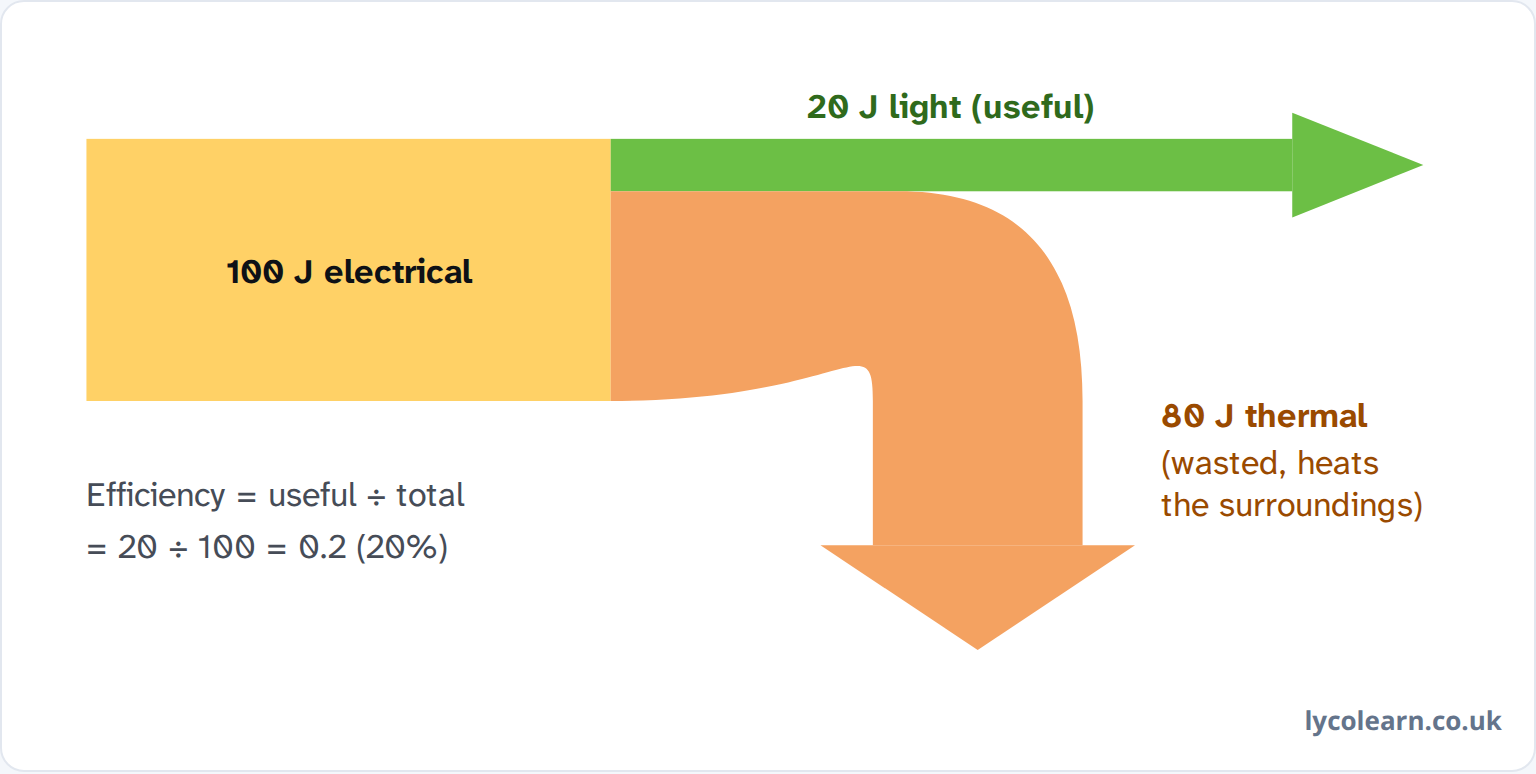
- Energy moves between stores by heating, by a force doing work, or by an electric current. Some always ends up wasted, usually heating the surroundings.
Energy stores
- Energy can be stored as kinetic, gravitational potential, elastic potential, thermal (internal), chemical, magnetic, electrostatic or nuclear energy.
- A moving object has energy in its kinetic store; a raised object has energy in its gravitational potential store.
Ways energy is transferred
- Mechanically: when a force moves an object (work done).
- Electrically: when a current flows.
- By heating, and by radiation such as light and sound.
Conservation of energy
- Energy can be transferred usefully, stored or dissipated, but it cannot be created or destroyed.
- In a closed system, the total energy stays the same.
- Wasted energy is usually dissipated to the surroundings as thermal energy.
Equations to learn
- Kinetic energy: Eₖ = ½ m v²
- Gravitational potential energy: Eₚ = m g h (g = 9.8 N/kg on Earth; Edexcel and OCR papers use 10 N/kg)
- Elastic potential energy: Eₑ = ½ k e²
- Work done: W = F s
Reducing unwanted energy transfers
- Lubrication reduces friction between moving parts.
- Thermal insulation reduces the rate of heat loss from buildings.
- Thicker walls made of materials with low thermal conductivity reduce energy transfer.
Exam tip
- Describe energy in stores and transfers: 'energy is transferred from the chemical store to the thermal store'.
- Copy the equation, substitute, then calculate. In kinetic energy, square the speed first.
Common mistakes
- Forgetting to square v.
- Saying energy is used up. It's transferred and spreads out.
- Leaving mass in grams when it should be in kilograms.
Key terms
- Energy store
- A way energy is held, such as kinetic, thermal or chemical.
- Kinetic energy
- Energy an object has because it is moving: Eₖ = ½mv².
- Gravitational potential energy
- Energy gained by raising an object: Eₚ = mgh.
- Elastic potential energy
- Energy stored in a stretched or squashed object: Eₑ = ½ke².
- Dissipated
- Spread out to the surroundings and wasted, usually as thermal energy.
- Closed system
- A system where no energy enters or leaves, so the total stays the same.
- Work done
- Energy transferred when a force moves an object: W = Fs.
- Conservation of energy
- Energy cannot be created or destroyed, only transferred.
Quick questions on Energy stores and transfers
- Which energy store increases when a ball is lifted up?
- Gravitational potential: Raising an object increases its gravitational potential store.
- Which equation gives kinetic energy?
- Eₖ = ½mv²: Kinetic energy = ½ × mass × speed².
- Energy cannot be created or destroyed. What is this called?
- Conservation of energy: This is the principle of conservation of energy.
- Where does most wasted energy end up?
- The thermal store of the surroundings: Wasted energy is dissipated as thermal energy.
- A 2 kg ball moves at 3 m/s. What is its kinetic energy?
- 9 J: ½ × 2 × 3² = 9 J.
- A 5 kg box is lifted 2 m (g = 9.8 N/kg). How much gravitational potential energy does it gain?
- 98 J: 5 × 9.8 × 2 = 98 J.
- Which of these is a way of transferring energy rather than a store?
- Heating: Heating is a transfer; chemical, kinetic and thermal are stores.
- In which store is the energy of a stretched spring?
- Elastic potential: Stretched or squashed objects store elastic potential energy.
- What does lubrication reduce?
- Friction: Oil or grease reduces friction between moving parts.
- What is a closed system?
- A system where no energy enters or leaves: In a closed system the total energy stays constant.
- What is the unit of energy?
- Joule (J): Energy is measured in joules.
- What is the value of g on Earth?
- 9.8 N/kg: Gravitational field strength on Earth is about 9.8 N/kg.
Energy stores and transfers: exam-style questions and mark schemes
Which equation gives the gravitational potential energy gained by an object? [1 mark]
Answer: Ep = mgh
A car of mass 1200 kg travels at 10 m/s. Calculate its kinetic energy. [2 marks]
- Eₖ = 0.5 × 1200 × 10² (1)
- Eₖ = 60 000 J (1)
A 0.50 kg ball is dropped from a height of 4.0 m (g = 9.8 N/kg). Calculate its speed just before it hits the ground. Ignore air resistance and give your answer to 2 significant figures. [3 marks]
- Eₚ = 0.50 × 9.8 × 4.0 = 19.6 J (1)
- 19.6 = ½ × 0.50 × v² (1)
- v = 8.9 m/s (1)
Describe the energy transfers from the moment a person kicks a football into the air until it reaches its highest point. [3 marks]
- Energy from the chemical store of the person is transferred mechanically to the kinetic store of the ball (1)
- As the ball rises, energy is transferred from its kinetic store to its gravitational potential store (1)
- Some energy is dissipated to the thermal store of the surroundings by air resistance (1)
What is the unit of energy? [1 mark]
Answer: Joule
A ball is thrown straight up into the air. Describe the changes in the way energy is stored as it rises and then falls back down. [3 marks]
- as it rises, energy is transferred from the kinetic store to the gravitational potential store (1)
- at the top, the kinetic store is (nearly) empty / gravitational potential store is maximum (1)
- as it falls, energy is transferred from the gravitational potential store back to the kinetic store (1)
A stone is dropped from a height of 20 m. Calculate its speed just before it hits the ground. Ignore air resistance. (g = 9.8 N/kg) [3 marks]
- mgh = ½mv², so v² = 2gh (1)
- v² = 2 × 9.8 × 20 = 392 (1)
- v = 19.8 m/s (accept 20 m/s) (1)
How to answer them: exam technique and command words.
Energy stores and transfers: questions and answers
- Which energy store is filled when an object is lifted up?
- Its gravitational potential energy store.
- What does lubrication reduce?
- Oil or grease reduces friction between moving parts.
- What is a closed system?
- A system where no energy enters or leaves. In a closed system the total energy stays constant.
- What is the unit of energy?
- Joule (J). Energy is measured in joules.