Start here: what electricity is
- An electric current is a flow of charge, carried by electrons moving through the wires. It only flows round a complete loop: a closed circuit.
- The cell or battery pushes the charge round. That push is the potential difference (voltage), measured in volts.
- Components such as lamps and resistors resist the flow. The bigger the resistance, the smaller the current for the same push.
Circuit symbols
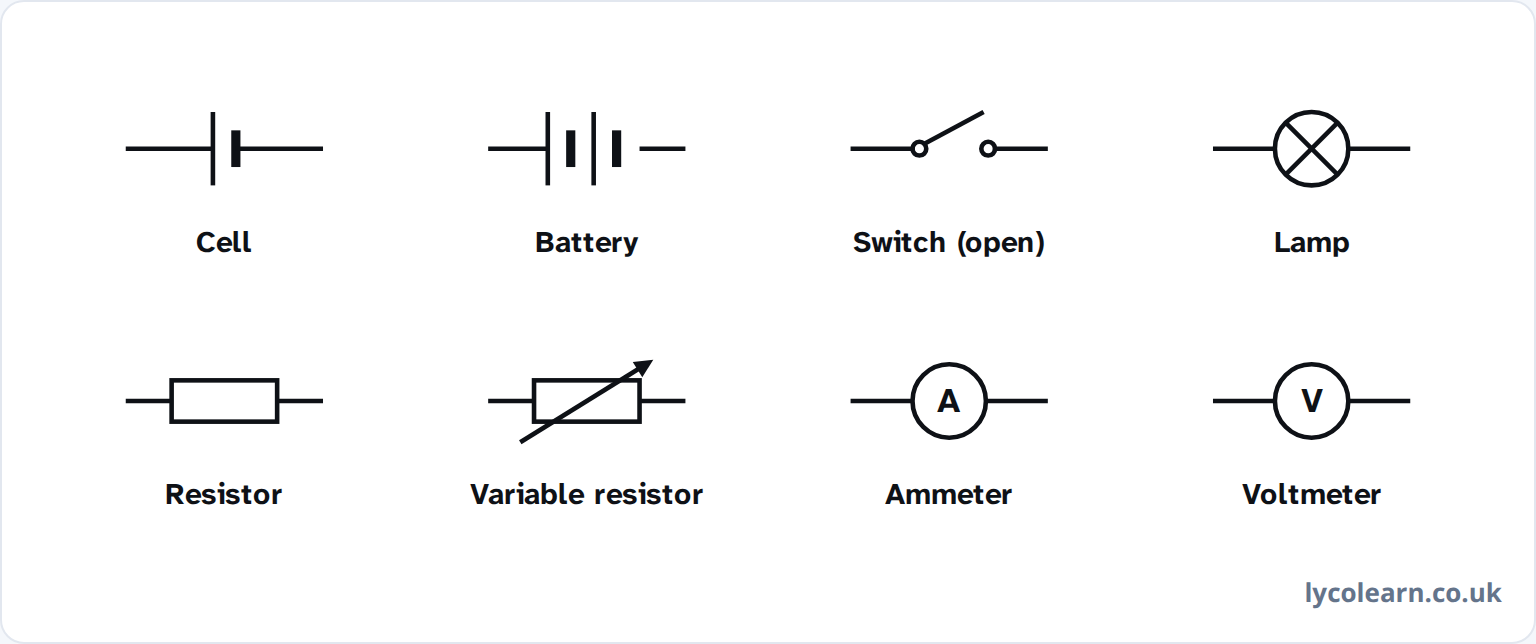
- Circuits are drawn with standard symbols: cell, battery, switch (open and closed), lamp, fuse, resistor, variable resistor, diode, LED, thermistor, LDR, ammeter and voltmeter.
- An ammeter measures current and is connected in series. A voltmeter measures potential difference and is connected in parallel across a component.
Charge and current
- For charge to flow through a closed circuit, the circuit must include a source of potential difference, such as a cell or battery.
- Electric current is a flow of electrical charge. The size of the current is the rate of flow of charge.
- Q = I t: charge (coulombs, C) = current (amperes, A) × time (seconds, s).
- The current is the same at any point in a single closed loop.
Potential difference
- Potential difference (pd, or voltage) is the energy transferred per unit of charge passing between two points. It is measured in volts (V).
- A cell provides the potential difference that pushes charge around the circuit.
Current, resistance and potential difference
- The current through a component depends on both the resistance of the component and the potential difference across it.
- The greater the resistance, the smaller the current for a given potential difference.
- V = I R: potential difference (V) = current (A) × resistance (ohms, Ω).
Exam tip
- Learn V = IR and Q = It, with their units. An ammeter goes in series, and a voltmeter goes in parallel.
- In a calculation, change minutes into seconds first.
Common mistakes
- Confusing current (the flow of charge) with potential difference (what pushes it).
- Drawing a voltmeter in series.
Key terms
- Electric current
- The rate of flow of electrical charge, measured in amperes (A).
- Charge
- A property of particles such as electrons, measured in coulombs (C).
- Potential difference
- The energy transferred per unit charge between two points, measured in volts (V).
- Resistance
- How much a component opposes the flow of current, measured in ohms (Ω).
- Ammeter
- A meter connected in series to measure current.
- Voltmeter
- A meter connected in parallel to measure potential difference.
- Closed circuit
- A complete loop that current can flow around.
- Coulomb
- The unit of charge (C).
Quick questions on Current, potential difference and charge
- What is electric current?
- The rate of flow of electrical charge: Current is measured in amperes.
- What is the unit of charge?
- Coulomb (C): Q = I t.
- How much charge flows when a current of 2 A flows for 30 s?
- 60 C: Q = 2 × 30 = 60 C.
- How is an ammeter connected?
- In series: All the current must flow through it.
- How is a voltmeter connected?
- In parallel across the component: It compares the energy of charge on each side of the component.
- What does a circuit need for charge to flow?
- A source of potential difference and a complete loop: The loop must be closed.
- What is the pd across a 12 Ω resistor with 0.5 A through it?
- 6 V: V = I R = 0.5 × 12 = 6 V.
- What is the resistance of a component with 12 V across it and 3 A through it?
- 4 Ω: R = V ÷ I = 12 ÷ 3 = 4 Ω.
- What happens to the current if resistance increases and pd stays the same?
- It decreases: I = V ÷ R.
- What is the unit of resistance?
- Ohm (Ω): 1 Ω = 1 V/A.
- How does the current compare at different points in a single loop?
- It is the same everywhere: Current is not used up.
Current, potential difference and charge: exam-style questions and mark schemes
Which equation links charge, current and time? [1 mark]
Answer: Q = I × t
A current of 0.25 A flows through a lamp for 2 minutes. Calculate the charge that flows. [2 marks]
- t = 120 s; Q = 0.25 × 120 (1)
- = 30 C (1)
The potential difference across a resistor is 9.0 V and the current through it is 0.30 A. Calculate its resistance. [3 marks]
- R = V ÷ I (1)
- = 9.0 ÷ 0.30 (1)
- = 30 Ω (1)
Explain why an ammeter must be connected in series but a voltmeter in parallel. [2 marks]
- An ammeter measures the current flowing through a component, so all the current must pass through it (1)
- A voltmeter measures the pd between two points, either side of a component (1)
A current of 2.0 A flows for 30 s. Calculate the charge that flows. [2 marks]
- Q = 2.0 × 30 (1)
- = 60 C (1)
A charge of 900 C flows through a heater in 5 minutes. Calculate the current. [3 marks]
- t = 300 s (1)
- I = Q ÷ t = 900 ÷ 300 (1)
- = 3.0 A (1)
A component has a pd of 6.0 V across it. A charge of 30 C flows through it in 1 minute. Calculate its resistance. [3 marks]
- I = Q ÷ t = 30 ÷ 60 = 0.50 (A) (1)
- R = V ÷ I = 6.0 ÷ 0.50 (1)
- = 12 Ω (1)
How to answer them: exam technique and command words.
More on Current, potential difference and charge
Current, potential difference and charge: questions and answers
- What happens to the current if resistance increases and pd stays the same?
- It decreases. I = V ÷ R.
- What is the unit of resistance?
- Ohm (Ω). 1 Ω = 1 V/A.
- How does the current compare at different points in a single loop?
- It is the same everywhere. Current is not used up.
Practise Current, potential difference and charge: 11 questions