Changes of state
- The changes of state are melting, freezing, boiling (and evaporating), condensing and sublimating (solid straight to gas).
- When a substance changes state, its mass is conserved.
- Changes of state are physical changes: if the change is reversed, the material gets back its original properties. They are not chemical changes.
Internal energy
- Internal energy is the energy stored inside a system by the particles that make it up. It is the total kinetic energy and potential energy of all the particles.
- Heating a system increases the energy of its particles. This either raises the temperature or produces a change of state.
Specific latent heat
- During a change of state, the energy supplied changes the internal energy (by breaking bonds between particles) but not the temperature.
- Specific latent heat is the energy needed to change the state of 1 kg of a substance with no change in temperature.
- E = m L: energy (J) = mass (kg) × specific latent heat (J/kg).
- Specific latent heat of fusion: changing between solid and liquid. Specific latent heat of vaporisation: changing between liquid and vapour.
Heating and cooling graphs
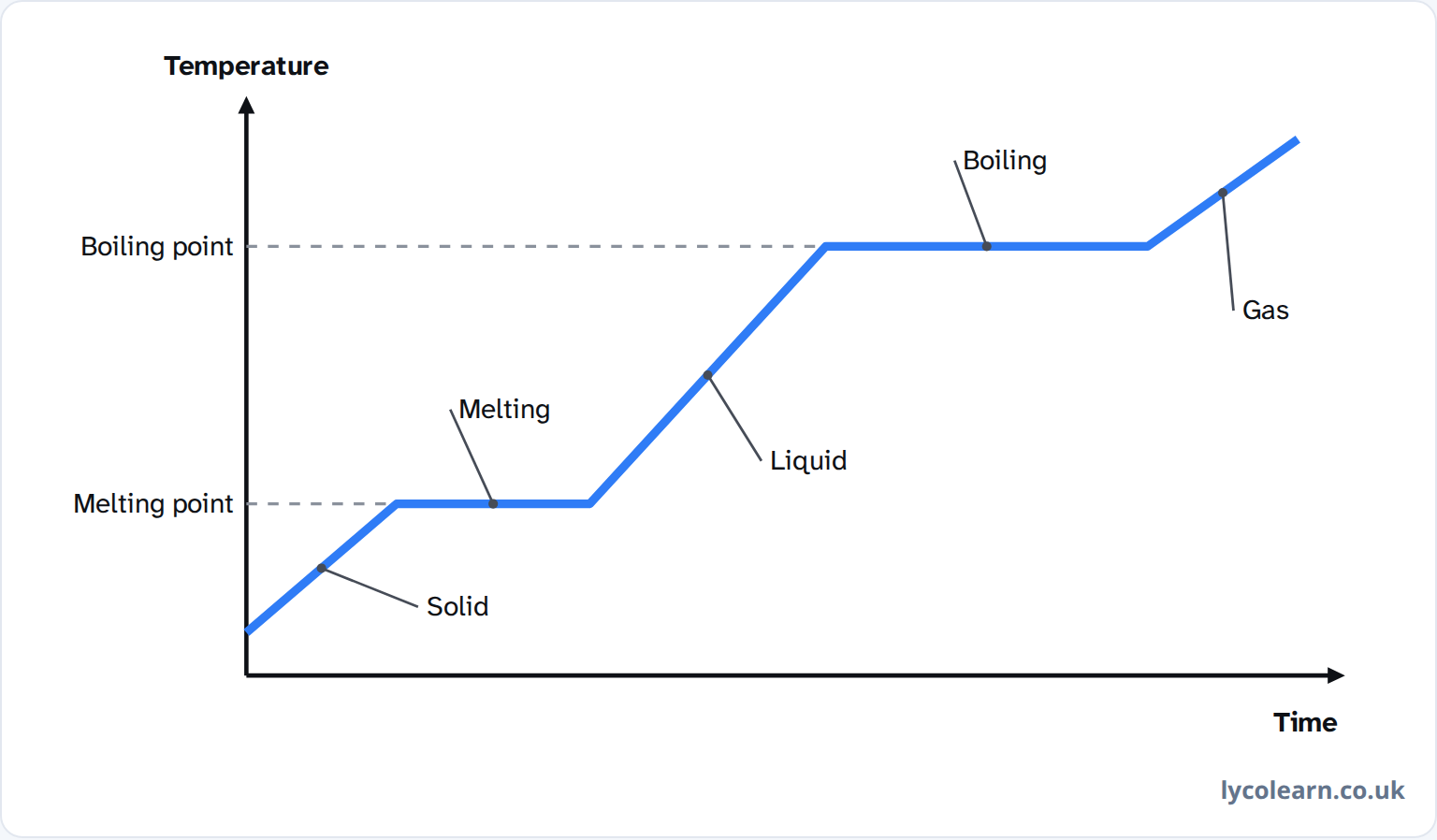
- A heating graph shows temperature against time. Where the line is flat, the substance is changing state, and energy is being used to break bonds.
- The first flat section is melting (at the melting point); the second is boiling (at the boiling point).
- On a cooling graph, the flat sections show condensing and freezing, where energy is released.
Key terms
- Internal energy
- The total kinetic and potential energy of all the particles in a system.
- Physical change
- A change, such as a change of state, that can be reversed.
- Specific latent heat
- The energy needed to change the state of 1 kg of a substance without changing its temperature.
- Specific latent heat of fusion
- The energy to melt (or freeze) 1 kg of a substance.
- Specific latent heat of vaporisation
- The energy to boil (or condense) 1 kg of a substance.
- Sublimation
- A change directly from solid to gas.
- Evaporation
- A liquid changing to a gas at its surface, below the boiling point.
Quick questions on Changes of state and specific latent heat
- Is a change of state a physical or chemical change?
- Physical: The substance keeps its original properties if the change is reversed.
- What happens to mass when ice melts?
- It stays the same: Mass is conserved.
- What is internal energy?
- The total kinetic and potential energy of the particles: It includes both kinetic and potential energy.
- What happens to temperature while a substance is melting?
- It stays the same: The energy breaks bonds instead of raising the temperature.
- What is specific latent heat?
- The energy to change the state of 1 kg without changing its temperature: E = m L.
- How much energy is needed to melt 0.5 kg of ice? (L = 334 000 J/kg)
- 167 000 J: E = 0.5 × 334 000 = 167 000 J.
- How much energy is needed to boil 0.2 kg of water? (L = 2 260 000 J/kg)
- 452 000 J: E = 0.2 × 2 260 000 = 452 000 J.
- What does a flat section on a heating graph show?
- A change of state: The temperature is constant while bonds are broken.
- Which latent heat is for changing between liquid and gas?
- Vaporisation: Fusion is for solid and liquid.
- What is sublimation?
- A solid changing directly into a gas: Dry ice (solid carbon dioxide) sublimes.
Changes of state and specific latent heat: exam-style questions and mark schemes
What does specific latent heat of fusion refer to? [1 mark]
Answer: Changing a solid into a liquid
Calculate the energy needed to boil away 0.4 kg of water at 100 °C. (Specific latent heat of vaporisation of water = 2 260 000 J/kg) [2 marks]
- E = m L = 0.4 × 2 260 000 (1)
- = 904 000 J (1)
1 008 000 J is needed to melt 3.0 kg of a solid at its melting point. Calculate the specific latent heat of fusion of the solid. [3 marks]
- L = E ÷ m (1)
- = 1 008 000 ÷ 3.0 (1)
- = 336 000 J/kg (1)
Explain why the temperature of water stays at 100 °C while it is boiling, even though it is still being heated. [3 marks]
- Energy is still being supplied, increasing the internal energy (1)
- The energy is used to break the bonds between particles (1)
- Instead of increasing their kinetic energy, so the temperature does not rise (1)
What happens to the temperature of a substance while it is changing state? [1 mark]
Answer: It stays the same
Define specific latent heat of vaporisation. [2 marks]
- the energy needed to change 1 kg of a substance from liquid to vapour (1)
- with no change in temperature (1)
Calculate the total energy needed to heat 0.20 kg of water from 20 °C to 100 °C and then boil it all away. (c = 4200 J/kg °C; L = 2 260 000 J/kg) [4 marks]
- heating: 0.20 × 4200 × 80 = 67 200 J (1)
- boiling: 0.20 × 2 260 000 = 452 000 J (1)
- total = 67 200 + 452 000 (1)
- = 519 200 J (1)
How to answer them: exam technique and command words.
More on Changes of state and specific latent heat
Changes of state and specific latent heat: questions and answers
- Which latent heat is for changing between liquid and gas?
- Vaporisation. Fusion is for solid and liquid.
- What is sublimation?
- A solid changing directly into a gas. Dry ice (solid carbon dioxide) sublimes.
Practise Changes of state and specific latent heat: 10 questions