The theorem
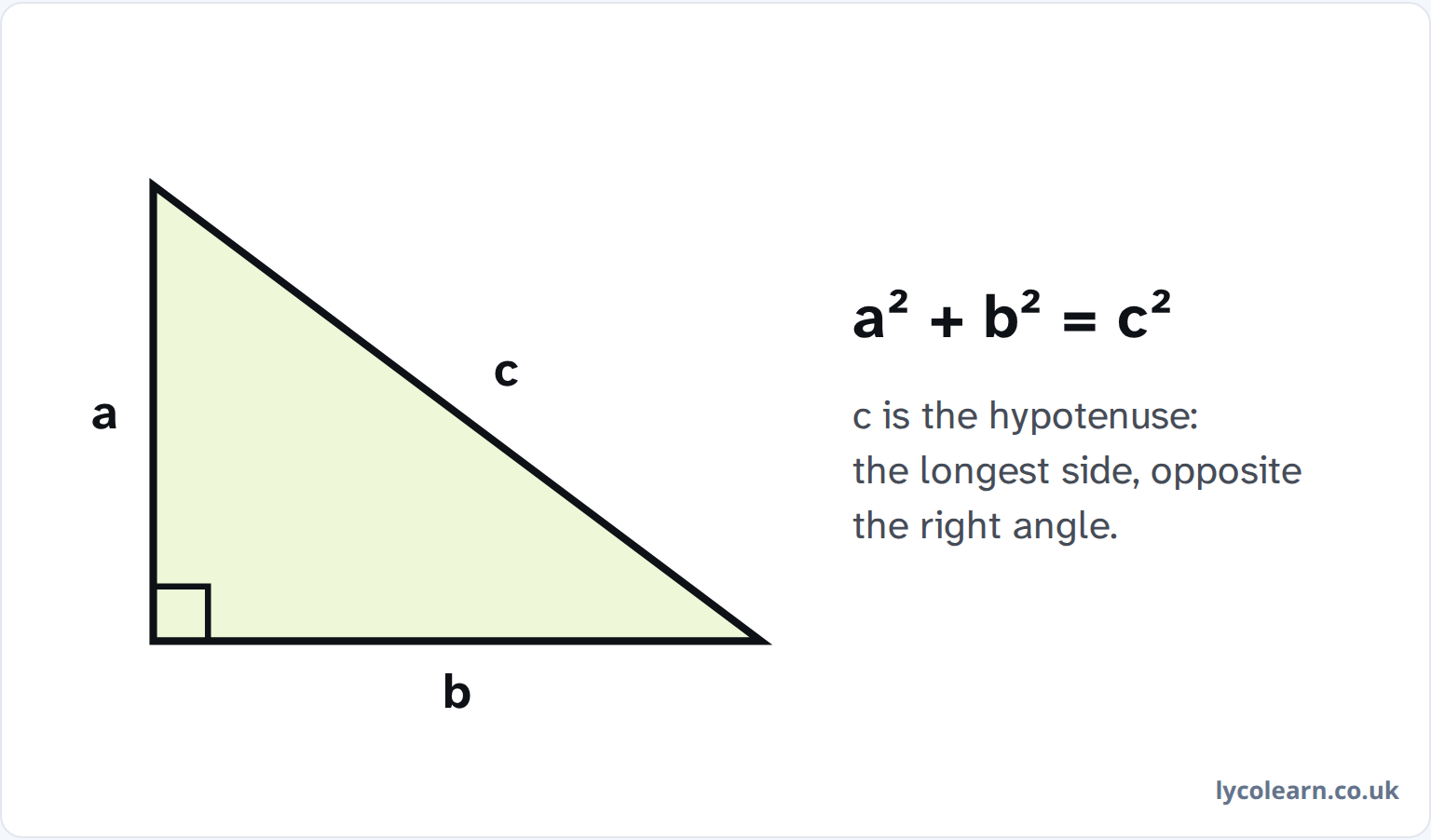
- In a right-angled triangle, a² + b² = c².
- c is the hypotenuse: the longest side, opposite the right angle.
Finding the hypotenuse
- Square the two shorter sides, add them, then square root.
- Sides 6 and 8: 36 + 64 = 100, so c = √100 = 10.
Finding a shorter side
- Square the hypotenuse and the known side, subtract, then square root.
- Hypotenuse 13, side 5: 169 − 25 = 144, so the side is 12.
Useful facts
- Pythagorean triples are whole-number sets such as 3, 4, 5; 5, 12, 13; and 8, 15, 17 (and multiples, like 6, 8, 10).
- To find the distance between two points, use the difference in x and the difference in y as the two shorter sides.
- If a² + b² = c² for a triangle's sides, the triangle is right-angled.
Key terms
- Hypotenuse
- The longest side of a right-angled triangle, opposite the right angle.
- Pythagoras' theorem
- In a right-angled triangle, a² + b² = c².
- Pythagorean triple
- Three whole numbers that fit a² + b² = c², such as 3, 4, 5.
- Square root
- The number that multiplies by itself to give a value: √144 = 12.
Quick questions on Pythagoras' theorem
- Which side of a right-angled triangle is the hypotenuse?
- The longest side, opposite the right angle: The hypotenuse is always opposite the right angle.
- The shorter sides are 6 cm and 8 cm. How long is the hypotenuse?
- 10 cm: 6² + 8² = 100, √100 = 10.
- The hypotenuse is 13 and one side is 5. How long is the other side?
- 12: 13² − 5² = 144, √144 = 12.
- Which of these is a Pythagorean triple?
- 5, 12, 13: 25 + 144 = 169.
- Is a triangle with sides 7, 24 and 25 right-angled?
- Yes, because 49 + 576 = 625: 7² + 24² = 25², so it is right-angled.
- What is the distance between (1, 2) and (4, 6)?
- 5: Differences 3 and 4: √(9 + 16) = 5.
- Pythagoras' theorem works for which triangles?
- Right-angled triangles: It only applies to right-angled triangles.
- The shorter sides are 5 and 7. What is the hypotenuse to 1 decimal place?
- 8.6: √(25 + 49) = √74 = 8.6.
- A 5 m ladder reaches 4 m up a wall. How far is its foot from the wall?
- 3 m: √(25 − 16) = 3 m.
- Complete the rule: a² + b² = ...
- c²: a² + b² = c².
Pythagoras' theorem: exam-style questions and mark schemes
A right-angled triangle has shorter sides of 9 cm and 12 cm. Work out the length of the hypotenuse. [3 marks]
- 9² + 12² (1)
- = 225 (1)
- 15 cm (1)
A rectangle is 20 cm long and its diagonal is 25 cm. Work out the width of the rectangle. [3 marks]
- 25² − 20² (1)
- = 225 (1)
- 15 cm (1)
Work out the distance between the points A(2, −1) and B(8, 7). [3 marks]
- Differences of 6 and 8 (1)
- 6² + 8² = 100 (1)
- 10 (1)
Is a triangle with sides 8 cm, 11 cm and 14 cm right-angled? Show how you decide. [2 marks]
- 8² + 11² = 185 and 14² = 196 (1)
- They are not equal, so the triangle is not right-angled (1)
Without a calculator: The two shorter sides of a right-angled triangle are 9 cm and 12 cm. Work out the length of the hypotenuse. [2 marks]
- 9² + 12² = 225 (1)
- 15 cm (1)
Without a calculator: A triangle has sides of 6 cm and 10 cm, and the angle between them is 30°. Without a calculator, work out its area. [2 marks]
- 1/2 × 6 × 10 × 1/2 (1)
- 15 cm² (1)
How to answer them: exam technique and command words.