Angle facts
- Angles on a straight line add up to 180°. Angles around a point add up to 360°.
- Vertically opposite angles are equal.
- Angles in a triangle add up to 180°. Angles in a quadrilateral add up to 360°.
- Acute angles are less than 90°, right angles are 90°, obtuse angles are between 90° and 180°, and reflex angles are between 180° and 360°.
Parallel lines
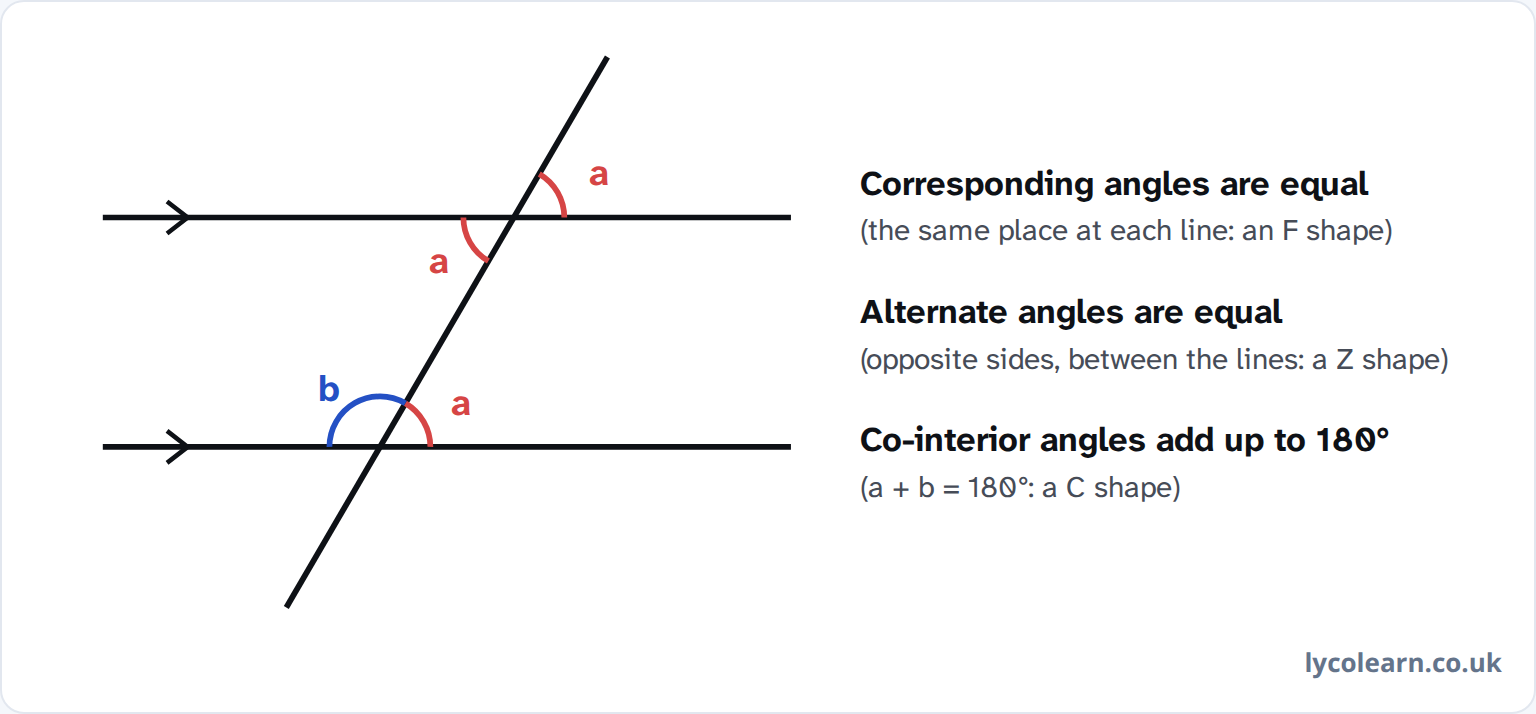
- Alternate angles are equal (they make a Z shape).
- Corresponding angles are equal (they make an F shape).
- Co-interior angles add up to 180° (they make a C shape).
Triangles
- The two base angles of an isosceles triangle are equal.
- Each angle in an equilateral triangle is 60°.
- The exterior angle of a triangle equals the sum of the two opposite interior angles.
Giving reasons
- In the exam, give a reason for each step using the proper words, such as 'alternate angles are equal'. Don't write 'Z angles'.
Key terms
- Acute angle
- An angle less than 90°.
- Obtuse angle
- An angle between 90° and 180°.
- Reflex angle
- An angle between 180° and 360°.
- Vertically opposite angles
- The equal angles opposite each other where two straight lines cross.
- Alternate angles
- Equal angles on opposite sides of a line crossing two parallel lines (a Z shape).
- Corresponding angles
- Equal angles in matching positions on parallel lines (an F shape).
- Co-interior angles
- Angles between two parallel lines on the same side, which add up to 180° (a C shape).
- Isosceles triangle
- A triangle with two equal sides and two equal angles.
Quick questions on Angles and parallel lines
- Two angles on a straight line are 65° and x. What is x?
- 115°: 180 − 65 = 115.
- Three angles around a point are 120°, 150° and x. What is x?
- 90°: 360 − 120 − 150 = 90.
- A triangle has angles of 50° and 60°. What is the third angle?
- 70°: 180 − 50 − 60 = 70.
- What is true about vertically opposite angles?
- They are equal: They are opposite each other where two lines cross.
- Which angles on parallel lines are equal and make a Z shape?
- Alternate angles: Alternate angles are on opposite sides of the crossing line.
- Which angles on parallel lines make an F shape?
- Corresponding angles: Corresponding angles are equal.
- What do co-interior angles on parallel lines add up to?
- 180°: They make a C shape.
- An isosceles triangle has a top angle of 40°. What is each base angle?
- 70°: (180 − 40) ÷ 2 = 70.
- What type of angle is 200°?
- Reflex: It is between 180° and 360°.
- Three angles of a quadrilateral are 80°, 95° and 110°. What is the fourth angle?
- 75°: 360 − 80 − 95 − 110 = 75.
- The exterior angle of a triangle is 130°. The two opposite interior angles are 70° and x. What is x?
- 60°: 130 − 70 = 60.
- Which reason would get the mark in an exam?
- Alternate angles are equal: Use the proper names for angle facts.
Angles and parallel lines: exam-style questions and mark schemes
Angles x and 3x lie on a straight line. What is x? [1 mark]
Answer: 45°
An isosceles triangle has one angle of 36°. Its other two angles are equal. Work out the size of one of the equal angles. [2 marks]
- 180 − 36 = 144 (1)
- 144 ÷ 2 = 72° (1)
Two parallel lines are crossed by a straight line. One of the angles formed is 68°. Explain why the co-interior angle to it is 112°. [2 marks]
- Co-interior angles add up to 180° (1)
- 180 − 68 = 112° (1)
The angles of a quadrilateral are x, 2x, 3x and 4x. Work out the size of the largest angle. [3 marks]
- x + 2x + 3x + 4x = 360 (1)
- 10x = 360, so x = 36 (1)
- Largest angle = 4 × 36 = 144° (1)
Without a calculator: Two angles on a straight line are 125° and x. Find x. [1 mark]
- x = 55° (1)
Without a calculator: The angles of a quadrilateral are x, 2x, 3x and 90°. Work out the size of the largest angle. [4 marks]
- x + 2x + 3x + 90 = 360 (1)
- 6x = 270 (1)
- x = 45 (1)
- 135° (1)
How to answer them: exam technique and command words.
Angles and parallel lines: questions and answers
- What type of angle is 200°?
- Reflex. It is between 180° and 360°.
- Three angles of a quadrilateral are 80°, 95° and 110°. What is the fourth angle?
- 75°. 360 − 80 − 95 − 110 = 75.
- The exterior angle of a triangle is 130°. The two opposite interior angles are 70° and x. What is x?
- 60°. 130 − 70 = 60.