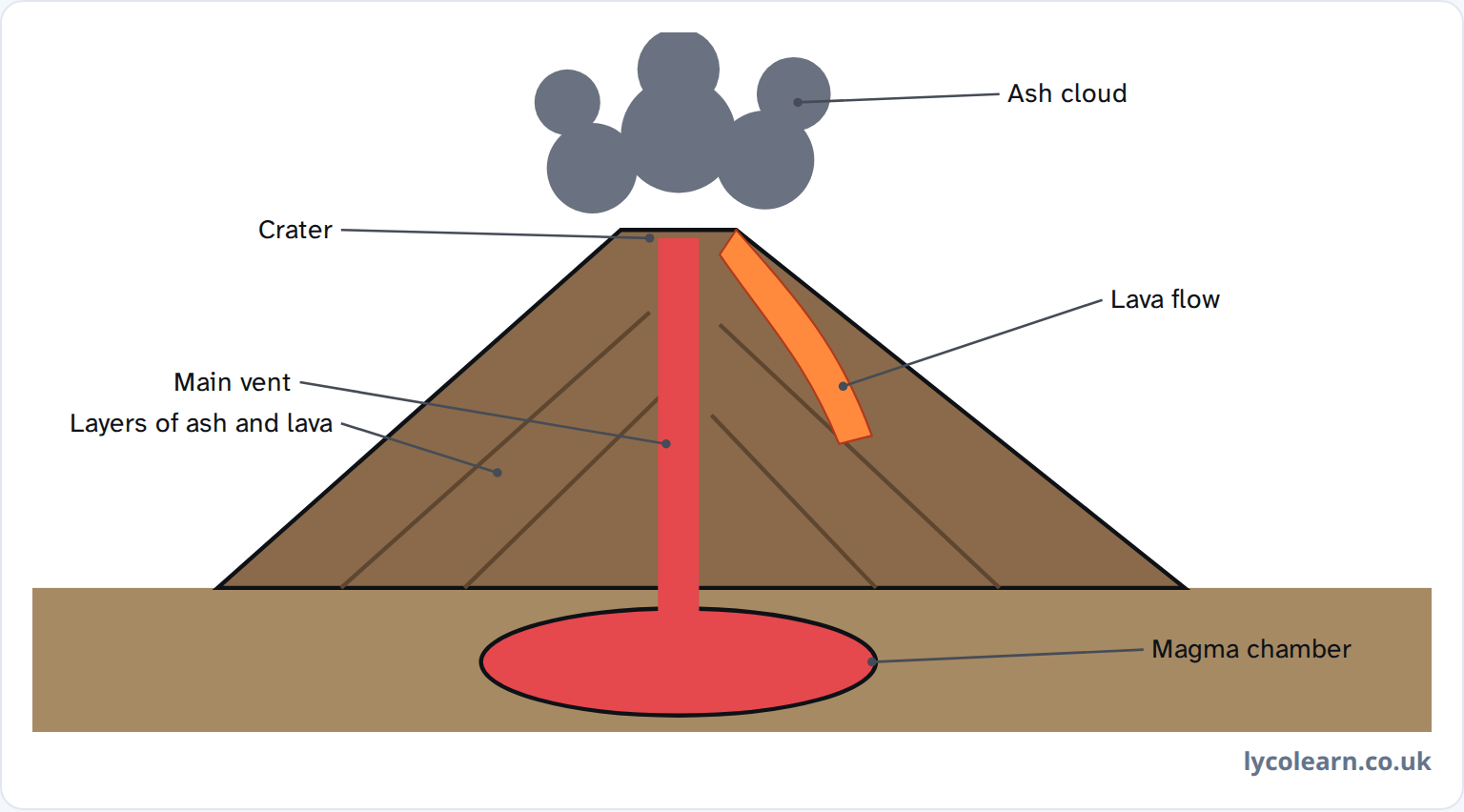
Plate tectonics
- The Earth's crust is split into tectonic plates that move slowly, driven by convection currents in the mantle and slab pull.
- Most earthquakes and volcanoes happen along plate margins.
Plate margins
- Destructive: an oceanic plate sinks (subducts) under a continental plate, causing explosive volcanoes and strong earthquakes.
- Constructive: plates move apart and magma rises to make new crust, with gentler volcanoes (e.g. Iceland).
- Conservative: plates slide past each other, causing earthquakes but no volcanoes (e.g. the San Andreas Fault).
Effects
- Primary effects happen straight away: buildings collapse, roads crack, people are injured or killed.
- Secondary effects happen later: fires, tsunamis, landslides, disease, loss of jobs and income.
Responses
- Immediate responses: search and rescue, medical care, emergency shelter, food and water.
- Long-term responses: rebuilding homes and infrastructure, stricter building codes, restoring the economy.
Case studies: Chile 2010 and Nepal 2015
- Chile (a higher-income country), 27 February 2010: a magnitude 8.8 earthquake off the coast, near Concepción. About 500 people died, and a tsunami hit coastal towns. The damage cost about US$30 billion. Strict building codes and quick emergency responses kept the death toll low, and the country recovered quickly.
- Nepal (a low-income country), 25 April 2015: a magnitude 7.8 earthquake in the Gorkha district, about 80 km north-west of Kathmandu. Nearly 9,000 people died, many old buildings collapsed, and landslides and avalanches followed, including on Mount Everest. Nepal needed international aid, and rebuilding took many years.
Reducing the risk
- Monitoring: seismometers, tiltmeters and gas measurements can warn that a volcano may erupt.
- Protection: earthquake-resistant buildings with deep foundations, cross-bracing and shock absorbers.
- Planning: hazard maps, evacuation routes and drills.
- People live near hazards because of fertile soil, geothermal energy, tourism, jobs and family ties.
Key terms
- Tectonic plate
- A large slab of the Earth's crust that moves slowly.
- Convection current
- Circulation of heat in the mantle that helps move the plates.
- Destructive margin
- Where an oceanic plate subducts under a continental plate.
- Constructive margin
- Where two plates move apart and new crust forms.
- Conservative margin
- Where two plates slide past each other.
- Subduction
- One plate sinking beneath another into the mantle.
- Epicentre
- The point on the surface directly above where an earthquake starts.
- Primary effect
- An effect caused directly by the hazard, straight away.
- Secondary effect
- An effect that happens later as a result of the primary effects.
Quick questions on Tectonic hazards
- At which type of margin do plates move apart?
- Constructive: Plates move apart at constructive margins.
- What happens at a destructive margin?
- An oceanic plate sinks under a continental plate: The denser oceanic plate subducts.
- Which margin has earthquakes but no volcanoes?
- Conservative: No magma rises where plates slide past each other.
- Which of these is a primary effect of an earthquake?
- Buildings collapsing: Primary effects happen straight away.
- Which of these is a secondary effect of an earthquake?
- Fires from broken gas pipes: Secondary effects are knock-on effects.
- What moves tectonic plates?
- Convection currents in the mantle: Heat from the core drives convection in the mantle.
- What is the point on the surface directly above where an earthquake starts?
- Epicentre: The focus is underground; the epicentre is above it.
- Which instrument detects earthquakes?
- Seismometer: Seismometers measure ground movement.
- Why do many people live near volcanoes?
- The soil is fertile for farming: Volcanic ash breaks down into rich soil.
- Which is an example of protection against earthquakes?
- Earthquake-resistant buildings: Well-designed buildings reduce deaths and damage.
- Why did the 2010 Chile earthquake kill far fewer people than the 2015 Nepal earthquake, even though it was stronger?
- Chile had stricter building codes and better emergency services: Wealth and preparation reduce the effects.
- Which of these happened after the 2015 Nepal earthquake?
- Avalanches on Mount Everest: Nepal is landlocked, so it had no tsunami.
Tectonic hazards: exam-style questions and mark schemes
Which type of plate margin is found at the San Andreas Fault? [1 mark]
Answer: Conservative
Explain why volcanoes form at destructive plate margins. [4 marks]
- The oceanic plate is denser, so it subducts under the continental plate (1)
- As it sinks it melts because of heat and friction, forming magma (1)
- The magma is less dense, so it rises through cracks in the crust (1)
- It erupts at the surface, building a volcano (1)
Suggest reasons why people continue to live in areas at risk from tectonic hazards. [4 marks]
- Fertile volcanic soils are good for farming (1)
- Geothermal energy, minerals or other jobs are available (1)
- Tourism brings in money (1)
- Family ties, being unable to afford to move, or trust in monitoring and building design (1)
Using named examples, compare the effects of a tectonic hazard in two areas of contrasting wealth. [6 marks]
- Names two examples, e.g. Chile 2010 (higher income) and Nepal 2015 (low income) (1)
- Primary effects compared, e.g. about 500 deaths in Chile against nearly 9,000 in Nepal (1)
- Secondary effects compared, e.g. the tsunami in Chile; landslides and avalanches in Nepal (1)
- Explains why Chile's effects were smaller: building codes, preparation, emergency services (1)
- Explains why Nepal's effects were larger: poorly built homes, remote mountain areas, poverty (1)
- Uses specific facts and reaches a clear comparison (1)
How to answer them: exam technique and command words.
Tectonic hazards: questions and answers
- Why do many people live near volcanoes?
- The soil is fertile for farming. Volcanic ash breaks down into rich soil.
- Which is an example of protection against earthquakes?
- Earthquake-resistant buildings. Well-designed buildings reduce deaths and damage.
- Why did the 2010 Chile earthquake kill far fewer people than the 2015 Nepal earthquake, even though it was stronger?
- Chile had stricter building codes and better emergency services. Wealth and preparation reduce the effects.