The three states
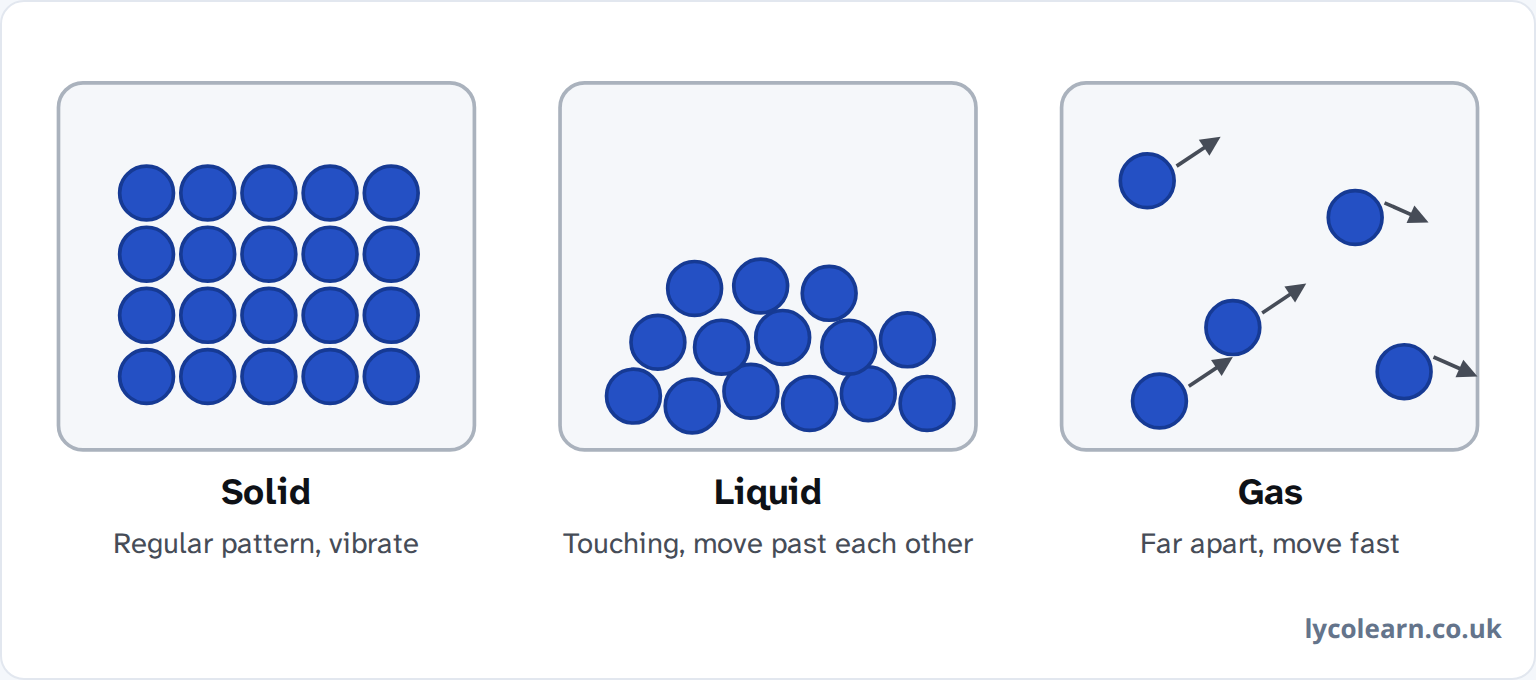
- Solids: particles are closely packed in a regular pattern and vibrate in fixed positions.
- Liquids: particles are close together but randomly arranged and can move around each other.
- Gases: particles are far apart, randomly arranged and move quickly in all directions.
Changes of state
- Melting and freezing happen at the melting point. Boiling and condensing happen at the boiling point.
- The amount of energy needed to change state depends on the strength of the forces between the particles. The stronger the forces, the higher the melting and boiling points.
- The nature of the particles (atoms, ions or molecules) and the type of bonding decide how strong these forces are.
Predicting states
- If the temperature is below the melting point, the substance is a solid.
- If it is between the melting point and the boiling point, it is a liquid.
- If it is above the boiling point, it is a gas.
Limitations of the particle model
- The simple model shows particles as small, solid, inelastic spheres.
- It does not show the forces between particles, the space between them accurately, or that particles may be atoms, ions or molecules of different shapes.
State symbols
- In equations, (s) means solid, (l) liquid, (g) gas and (aq) aqueous (dissolved in water).
- Example: NaCl(aq) + AgNO₃(aq) → AgCl(s) + NaNO₃(aq).
Key terms
- Melting point
- The temperature at which a solid turns into a liquid (and a liquid freezes).
- Boiling point
- The temperature at which a liquid turns into a gas (and a gas condenses).
- Particle model
- A model that explains the states of matter using the arrangement and movement of particles.
- Aqueous
- Dissolved in water, shown by (aq).
- Condensing
- A gas turning into a liquid.
- Freezing
- A liquid turning into a solid.
- State symbol
- A letter in brackets showing the state of a substance in an equation.
Quick questions on States of matter and state symbols
- How are particles arranged in a solid?
- Closely packed in a regular pattern: They vibrate in fixed positions.
- How do particles move in a gas?
- Quickly in all directions: Gas particles are far apart.
- What does the state symbol (aq) mean?
- Dissolved in water: Aqueous means in water solution.
- What happens at the boiling point?
- A liquid turns into a gas: Condensing also happens at the boiling point.
- A substance melts at −7 °C and boils at 59 °C. What state is it at 20 °C?
- Liquid: 20 °C is between the melting and boiling points.
- A substance melts at 801 °C. What state is it at 25 °C?
- Solid: 25 °C is below its melting point.
- What decides how much energy is needed to melt a substance?
- The strength of the forces between the particles: Stronger forces need more energy to overcome.
- What is a limitation of the particle model?
- It shows particles as solid spheres with no forces between them: Real particles are not solid, inelastic spheres.
- What is the state symbol for a liquid?
- (l): Water at room temperature is H₂O(l).
- What change of state is condensing?
- Gas to liquid: It happens at the boiling point as a gas cools.
States of matter and state symbols: exam-style questions and mark schemes
Bromine melts at −7 °C and boils at 59 °C. What is its state at 70 °C? [1 mark]
Answer: Gas
Describe the arrangement and movement of particles in a liquid. [3 marks]
- Particles are close together (1)
- They are arranged randomly (1)
- They can move around each other (1)
Explain why substances with stronger forces between particles have higher boiling points. [2 marks]
- More energy is needed to overcome stronger forces (1)
- So a higher temperature is needed before the particles can separate (1)
Give two limitations of the simple particle model. [2 marks]
- It shows particles as solid, inelastic spheres (1)
- It does not show the forces between particles (or that particles can be different shapes) (1)
What is the name of the change of state from gas to liquid? [1 mark]
Answer: Condensing
Explain why sodium chloride has a high melting point. [3 marks]
- giant (ionic) lattice (1)
- strong electrostatic forces of attraction between oppositely charged ions (1)
- a lot of energy needed to overcome them (1)
Silicon dioxide melts at 1710 °C. Carbon dioxide is a gas at room temperature. Both contain covalent bonds. Explain the difference in their melting points. [4 marks]
- silicon dioxide has a giant covalent structure (1)
- many strong covalent bonds must be broken to melt it / lots of energy (1)
- carbon dioxide is made of small molecules (1)
- only weak intermolecular forces are overcome / little energy needed (1)
How to answer them: exam technique and command words.
States of matter and state symbols: questions and answers
- What is the state symbol for a liquid?
- Water at room temperature is H₂O(l).
- What change of state is condensing?
- Gas to liquid. It happens at the boiling point as a gas cools.