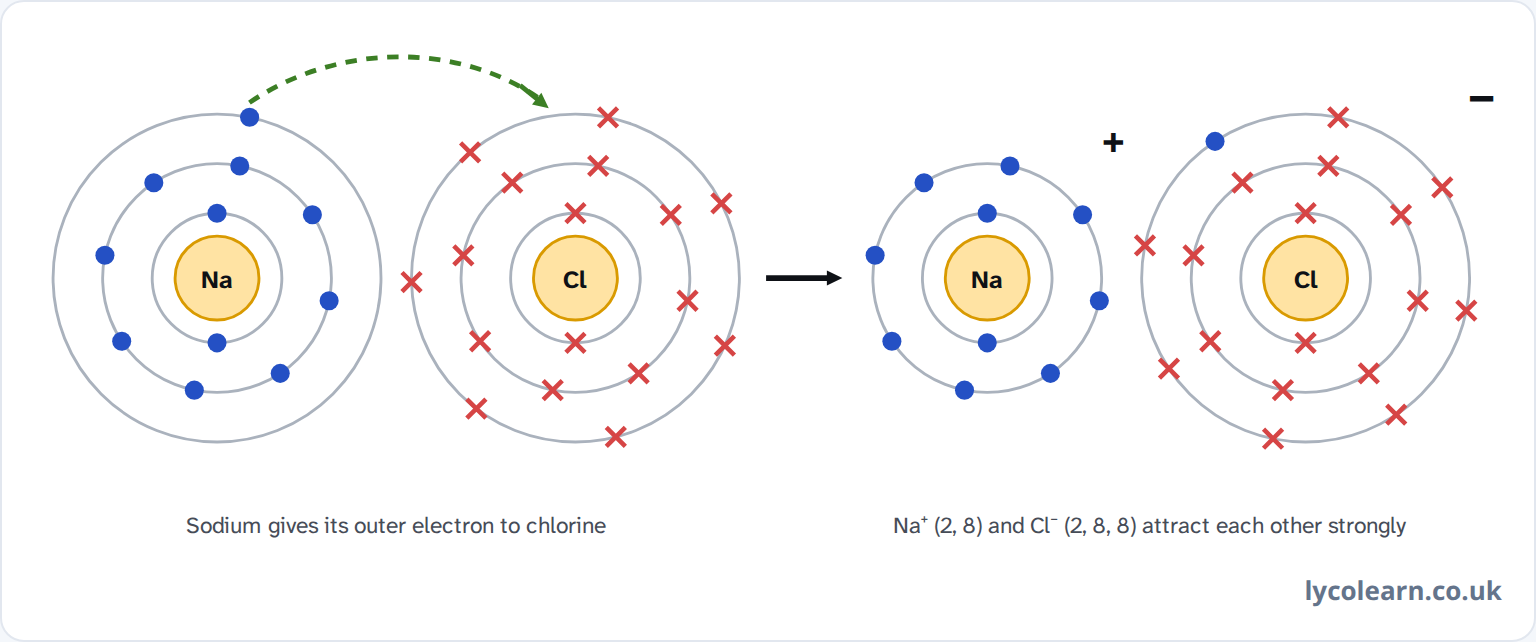
Start here: why atoms form ions
- Atoms are most stable with a full outer shell, like the noble gases. A metal and a non-metal can both get one by moving electrons from one to the other.
- Metal atoms lose their few outer electrons and become positive ions. Non-metal atoms gain electrons and become negative ions.
- The positive and negative ions attract each other strongly. This attraction is an ionic bond.
Three types of bonding
- Ionic bonding happens between metals and non-metals: oppositely charged ions attract.
- Covalent bonding happens between non-metals: atoms share pairs of electrons.
- Metallic bonding happens in metals and alloys: atoms share delocalised electrons.
Forming ions
- When a metal reacts with a non-metal, electrons are transferred from the metal atoms to the non-metal atoms.
- Metal atoms lose electrons to become positive ions; non-metal atoms gain electrons to become negative ions.
- The ions have the electronic structure of a noble gas (a full outer shell).
- Group 1 ions are +1, group 2 are +2, group 6 are −2 and group 7 are −1.
- Dot and cross diagrams show the transfer: for example, sodium gives one electron to chlorine to form Na⁺ and Cl⁻.
Ionic compounds
- An ionic compound is a giant structure of ions (a giant ionic lattice), like sodium chloride.
- It is held together by strong electrostatic forces of attraction between oppositely charged ions. These act in all directions.
- The formula shows the ratio of ions so the charges balance: Na⁺ and Cl⁻ give NaCl; Mg²⁺ and Cl⁻ give MgCl₂.
- Diagrams have limitations: dot and cross diagrams don't show the 3D structure; ball and stick models show gaps between ions that aren't really there.
Properties of ionic compounds
- They have high melting and boiling points, because lots of energy is needed to break the many strong bonds.
- They conduct electricity when melted or dissolved in water, because the ions are free to move and carry charge.
- They do not conduct when solid, because the ions are held in fixed positions.
Exam tip
- Say electrons are transferred, and that the bond is a strong electrostatic attraction between oppositely charged ions, in all directions.
- In dot and cross diagrams, show the outer shells, square brackets and the charge.
Common mistakes
- Saying ionic bonds share electrons.
- Saying electrons carry the current in a molten ionic compound. It's the ions that move.
- Forgetting the charges on a diagram.
Key terms
- Ion
- An atom or group of atoms with an electric charge because it has lost or gained electrons.
- Ionic bond
- The strong electrostatic attraction between oppositely charged ions.
- Ionic compound
- A compound made of positive and negative ions in a giant lattice.
- Giant ionic lattice
- A regular 3D arrangement of oppositely charged ions.
- Electrostatic force
- The force of attraction between opposite charges.
- Dot and cross diagram
- A diagram showing how electrons are transferred or shared, using dots and crosses.
- Cation
- A positive ion.
- Anion
- A negative ion.
Quick questions on Ionic bonding
- What type of bonding forms between a metal and a non-metal?
- Ionic: Electrons are transferred from metal to non-metal.
- What happens to a metal atom in ionic bonding?
- It loses electrons to become a positive ion: Metals form positive ions.
- What is the charge on a magnesium ion?
- 2+: Magnesium is in group 2, so it loses two electrons.
- What is the charge on an oxide ion?
- 2−: Oxygen is in group 6, so it gains two electrons.
- What holds the ions together in sodium chloride?
- Strong electrostatic forces between oppositely charged ions: These forces act in all directions.
- Why does sodium chloride have a high melting point?
- Lots of energy is needed to break the many strong ionic bonds: The giant lattice has many strong bonds.
- When can ionic compounds conduct electricity?
- When melted or dissolved in water: The ions must be free to move.
- What is the formula of the compound formed from Mg²⁺ and Cl⁻ ions?
- MgCl₂: Two Cl⁻ ions balance one Mg²⁺ ion.
- Why don't solid ionic compounds conduct electricity?
- The ions are held in fixed positions: The ions can only vibrate.
- What is the formula of calcium oxide (Ca²⁺ and O²⁻)?
- CaO: The 2+ and 2− charges balance one to one.
- Which electronic structure do ions from groups 1, 2, 6 and 7 have?
- The structure of a noble gas: They have full outer shells.
Ionic bonding: exam-style questions and mark schemes
Which statement describes an ionic bond? [1 mark]
Answer: The electrostatic attraction between oppositely charged ions
Describe what happens when sodium reacts with chlorine to form sodium chloride, in terms of electrons. [3 marks]
- Sodium atoms each lose one electron (1)
- Chlorine atoms each gain one electron (1)
- Forming Na⁺ and Cl⁻ ions, both with noble gas electronic structures (1)
Explain why magnesium oxide conducts electricity when molten but not when solid. [2 marks]
- When molten, the ions are free to move and carry charge (1)
- When solid, the ions are held in fixed positions in the lattice (1)
Explain why sodium chloride has a high melting point. [4 marks]
- Sodium chloride has a giant ionic lattice (1)
- There are strong electrostatic forces of attraction between the oppositely charged ions (1)
- These act in all directions and there are many of them (1)
- So a lot of energy is needed to overcome them (1)
Which type of bonding is found in sodium chloride? [1 mark]
Answer: Ionic
Describe what happens when sodium atoms react with chlorine atoms to form sodium chloride. Give your answer in terms of electrons. [4 marks]
- sodium atom loses one electron (1)
- chlorine atom gains one electron (1)
- (electron is transferred) forming Na⁺ and Cl⁻ ions (1)
- ions have full outer shells / the electronic structure of a noble gas (1)
Magnesium (atomic number 12) reacts with oxygen (atomic number 8) to form magnesium oxide. (a) Describe, in terms of electrons, how magnesium oxide is formed. Give the electronic structures of the ions formed. [4 marks] (b) A diagram of an ionic compound shows 8 potassium ions and 4 oxide ions. Work out the empirical formula of the compound and explain your answer using the charges on the ions. [2 marks] [6 marks]
- (a) magnesium atom loses two electrons (1)
- (a) oxygen atom gains two electrons (1)
- (a) Mg²⁺ ion has electronic structure 2,8 (1)
- (a) O²⁻ ion has electronic structure 2,8 (1)
- (b) K₂O (1)
- (b) K⁺ and O²⁻ / two 1+ charges balance one 2− charge (ratio 8 : 4 = 2 : 1) (1)
How to answer them: exam technique and command words.
More on Ionic bonding
Ionic bonding: questions and answers
- Elements that can react to form positive ions are called what?
- Metals. Metal atoms lose their outer electrons to become positive ions.
- Ions always have the same electronic structure as elements in which group of the periodic table?
- Group 0, the noble gases: each ion has a full outer shell.
- Why don't solid ionic compounds conduct electricity?
- The ions are held in fixed positions. The ions can only vibrate.
- What is the formula of calcium oxide (Ca²⁺ and O²⁻)?
- CaO. The 2+ and 2− charges balance one to one.
- Which electronic structure do ions from groups 1, 2, 6 and 7 have?
- The structure of a noble gas. They have full outer shells.