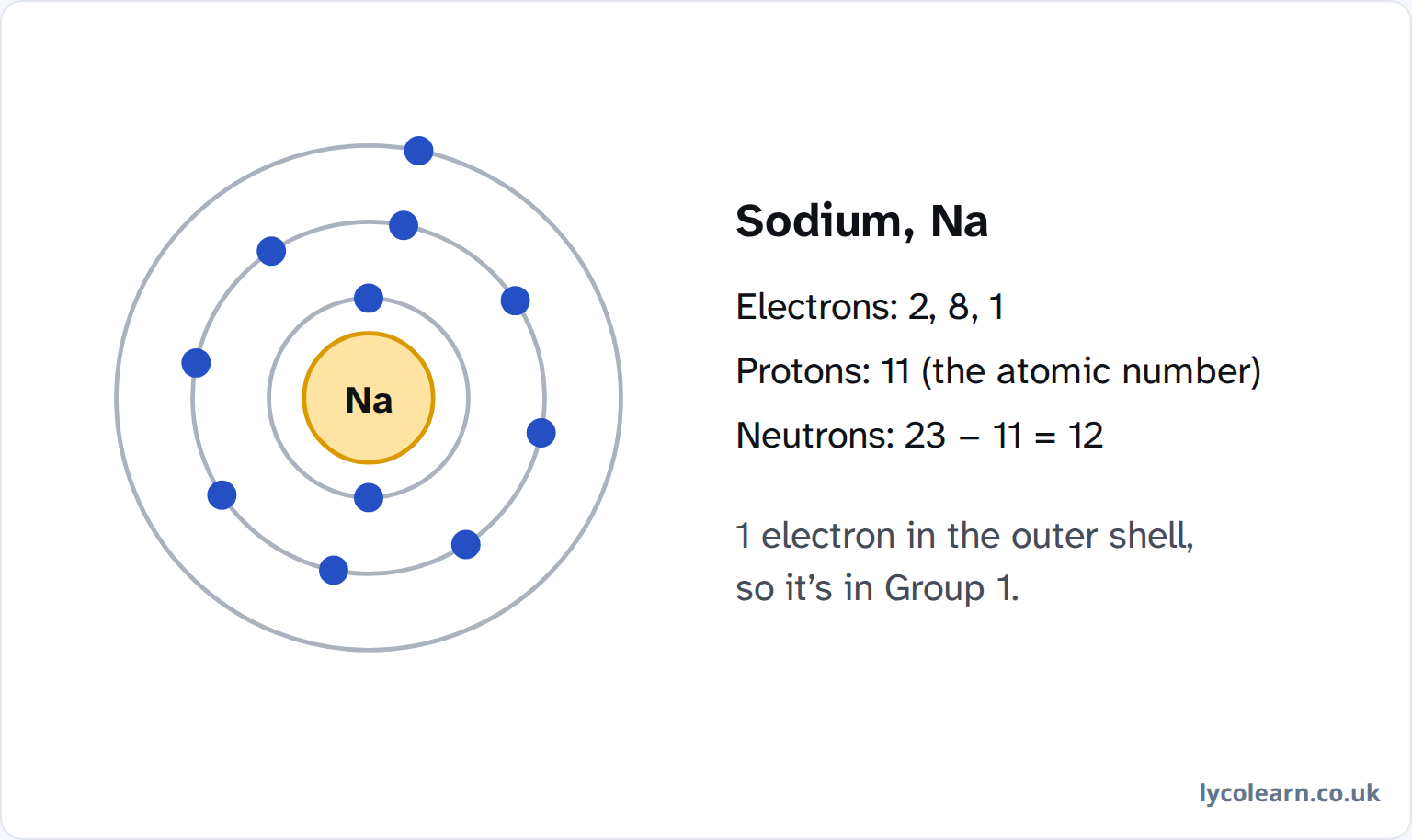
Start here: where the electrons are
- Electrons are not scattered randomly round the nucleus: they are in shells (energy levels), and the shells nearest the nucleus fill first.
- For the first 20 elements, the first shell holds up to 2 electrons, and the second and third shells up to 8 each.
- The number of electrons in the outer shell decides how an element reacts, and it is the same as its group number.
Electron shells
- Electrons occupy the lowest available energy levels (shells), starting nearest the nucleus.
- For the first 20 elements, the first shell holds up to 2 electrons, the second up to 8, and the third up to 8 (the fourth shell starts at potassium).
- Electronic structures are written as numbers, for example sodium (11 electrons) is 2,8,1.
Working out electronic structure
- The number of electrons equals the atomic number (for a neutral atom).
- Fill the shells in order: 2, then 8, then 8, then the rest.
- Examples: carbon (6) is 2,4; oxygen (8) is 2,6; chlorine (17) is 2,8,7; calcium (20) is 2,8,8,2.
Structure and the periodic table
- The number of shells tells you the period (row). The number of electrons in the outer shell tells you the group (for groups 1 to 7).
- For example, magnesium is 2,8,2: period 3, group 2.
- Elements in the same group have the same number of outer electrons, so they react in similar ways.
- Group 0 elements have full outer shells, which is why they are unreactive.
Electronic structure of ions
- Metal atoms lose outer electrons to form positive ions: Na (2,8,1) becomes Na⁺ (2,8).
- Non-metal atoms gain electrons to form negative ions: Cl (2,8,7) becomes Cl⁻ (2,8,8).
- The ions have the same electronic structure as a noble gas.
Exam tip
- Link electrons to the periodic table: outer electrons give the group, and the number of shells gives the period.
- Fill shells as 2, 8, 8 for the first 20 elements, and show them clearly in a diagram.
Common mistakes
- Putting three electrons in the first shell.
- Counting electrons for an atom when the question asks about an ion.
Key terms
- Electronic structure
- The arrangement of electrons in shells, such as 2,8,1.
- Energy level
- A shell in which electrons are found, at a particular distance from the nucleus.
- Outer shell
- The highest occupied energy level; its electrons decide how an element reacts.
- Period
- A horizontal row in the periodic table; its number equals the number of occupied shells.
- Group
- A vertical column in the periodic table; for groups 1 to 7 it matches the number of outer electrons.
- Ion
- An atom or group of atoms that has gained or lost electrons, so it has a charge.
- Noble gas structure
- A full outer shell, which is very stable.
Quick questions on Electronic structure
- How many electrons can the first shell hold?
- 2: The first shell holds a maximum of 2.
- What is the electronic structure of sodium (11 electrons)?
- 2,8,1: 2 in the first shell, 8 in the second, 1 in the third.
- What is the electronic structure of chlorine (17 electrons)?
- 2,8,7: Chlorine has 7 outer electrons, like all group 7 elements.
- An element has the structure 2,8,3. Which group is it in?
- Group 3: The outer shell has 3 electrons.
- An element has the structure 2,8,3. Which period is it in?
- Period 3: It has three occupied shells.
- What is the electronic structure of calcium (20 electrons)?
- 2,8,8,2: The fourth shell starts filling after the third holds 8.
- Why do elements in the same group react in similar ways?
- They have the same number of outer electrons: Outer electrons take part in reactions.
- What is the electronic structure of a sodium ion, Na⁺?
- 2,8: Sodium loses its single outer electron.
- What is the electronic structure of an oxygen atom (8 electrons)?
- 2,6: Oxygen has 6 outer electrons.
- Why are group 0 elements unreactive?
- They have full outer shells: A full outer shell is very stable.
Electronic structure: exam-style questions and mark schemes
Which electronic structure belongs to an element in group 2? [1 mark]
Answer: 2,8,2
Aluminium has atomic number 13. Give its electronic structure and use it to state its group. [2 marks]
- 2,8,3 (1)
- Group 3, because it has 3 outer electrons (1)
Write the electronic structures of a chlorine atom and a chloride ion (Cl⁻). [2 marks]
- Chlorine atom: 2,8,7 (1)
- Chloride ion: 2,8,8 (1)
Explain how the electronic structure of an atom is linked to its position in the periodic table. [3 marks]
- The number of occupied shells gives the period (1)
- The number of electrons in the outer shell gives the group (for groups 1 to 7) (1)
- So elements in the same group have the same number of outer electrons and similar reactions (1)
Draw or describe the electronic structure of a chlorine atom (atomic number 17), and state the group it is in. [2 marks]
- 2,8,7 (2 in first shell, 8 in second, 7 in third) (1)
- Group 7 (1)
How to answer them: exam technique and command words.
Electronic structure: questions and answers
- Ions always have the same electronic structure as elements in which group of the periodic table?
- Group 0, the noble gases: ions have a full outer shell, like a noble gas.
- What is the electronic structure of a sodium ion?
- 2,8. Sodium (2,8,1) loses its one outer electron to become Na⁺.
- What is the electronic structure of an oxygen atom (8 electrons)?
- 2,6. Oxygen has 6 outer electrons.
- Why are group 0 elements unreactive?
- They have full outer shells. A full outer shell is very stable.