Start here: splitting compounds with electricity
- Electrolysis uses electricity to split an ionic compound into its elements. The compound has to be melted or dissolved, so its ions are free to move.
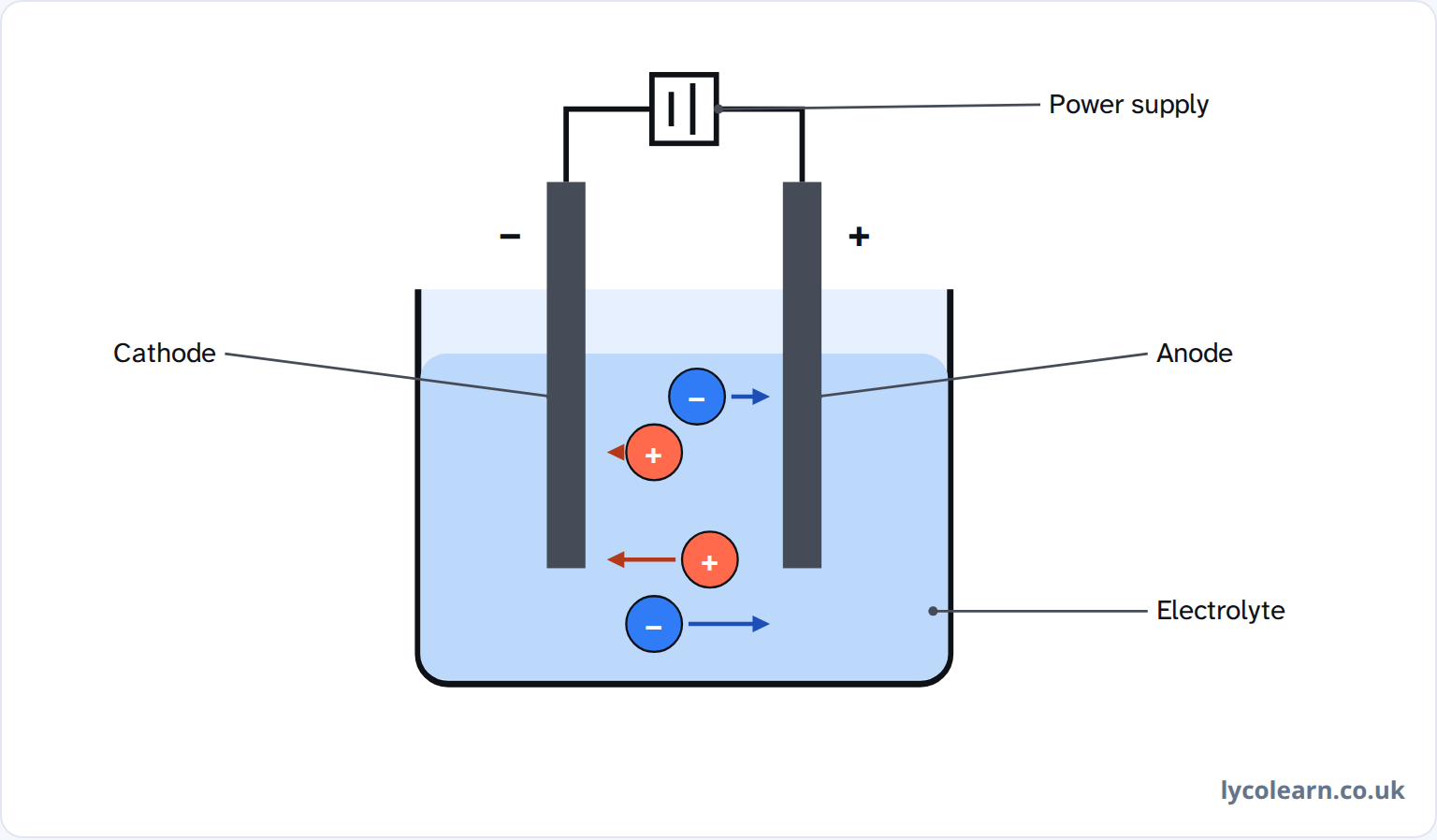
- Two electrodes dip into the liquid. Opposites attract: positive ions move to the negative electrode (the cathode), and negative ions move to the positive electrode (the anode).
- At the electrodes, the ions gain or lose electrons and turn back into atoms or molecules. That is where the products form.
How electrolysis works
- When an ionic compound is melted or dissolved in water, its ions are free to move. The liquid or solution is called an electrolyte.
- Passing an electric current through the electrolyte makes the ions move to the electrodes.
- Positive ions move to the negative electrode (cathode). Negative ions move to the positive electrode (anode).
- At the electrodes, ions are discharged to form elements.
Molten ionic compounds
- In a molten compound, the metal forms at the cathode and the non-metal at the anode.
- Example: molten lead bromide gives lead at the cathode and bromine at the anode.
Extracting aluminium
- Metals too reactive to be extracted by carbon, such as aluminium, are extracted by electrolysis of their molten compounds. This uses large amounts of energy to melt the compound and make the current.
- Aluminium is made by electrolysing a molten mixture of aluminium oxide and cryolite. Cryolite lowers the melting point, saving energy.
- Aluminium forms at the cathode; oxygen forms at the carbon anode.
- The oxygen reacts with the carbon anodes to form carbon dioxide, so the anodes wear away and must be replaced regularly.
Aqueous solutions
- In aqueous solutions, water also forms some H⁺ and OH⁻ ions, so the products depend on reactivity.
- At the cathode: hydrogen is produced if the metal is more reactive than hydrogen; otherwise the metal forms (for example copper).
- At the anode: oxygen is produced, unless the solution contains halide ions, when the halogen (such as chlorine) is produced.
- Examples: sodium chloride solution gives hydrogen and chlorine, leaving sodium hydroxide solution. Copper sulfate solution gives copper and oxygen.
Half equations, step by step (Higher)
- A half equation shows what happens to the ions at one electrode. An electron is written as e⁻.
- At the cathode, positive ions gain electrons. Gaining electrons is reduction. A 2+ ion gains 2 electrons: Cu²⁺ + 2e⁻ → Cu.
- At the anode, negative ions lose electrons. Losing electrons is oxidation. Two Cl⁻ ions each lose an electron to make one Cl₂ molecule: 2Cl⁻ → Cl₂ + 2e⁻.
- Remember OIL RIG: Oxidation Is Loss, Reduction Is Gain (of electrons).
- To write one: write the ion and what it becomes, balance the atoms, then add electrons to the side that needs them, so the charges balance.
- Hydrogen ions at the cathode make hydrogen: 2H⁺ + 2e⁻ → H₂. Hydroxide ions at the anode make oxygen: 4OH⁻ → O₂ + 2H₂O + 4e⁻.
Exam tip
- Say where the ions go: positive ions go to the negative electrode (cathode) and gain electrons; negative ions go to the positive electrode (anode) and lose electrons.
- For solutions, hydrogen forms at the cathode unless the metal is less reactive than hydrogen. Oxygen forms at the anode, unless there's a halide.
Common mistakes
- Sending positive ions to the positive electrode.
- Using the molten rules for a solution.
- (Higher) Half equations whose charges don't balance.
Key terms
- Electrolysis
- Breaking down an ionic compound using electricity.
- Electrolyte
- A molten or dissolved ionic compound that conducts electricity.
- Electrode
- A conductor through which current enters or leaves the electrolyte.
- Cathode
- The negative electrode, where positive ions gain electrons.
- Anode
- The positive electrode, where negative ions lose electrons.
- Discharged
- When an ion gains or loses electrons at an electrode to form an element.
- Cryolite
- A compound added to aluminium oxide to lower its melting point.
- Inert electrode
- An electrode, such as graphite or platinum, that does not react.
- Half equation
- An equation showing the electrons gained or lost at one electrode.
Quick questions on Electrolysis
- Why must ionic compounds be molten or dissolved for electrolysis?
- So the ions are free to move: In a solid the ions are fixed in place.
- Which ions move to the cathode?
- Positive ions: The cathode is negative, so it attracts positive ions.
- What forms at the cathode when molten lead bromide is electrolysed?
- Lead: The metal forms at the cathode.
- Why is cryolite used in the extraction of aluminium?
- To lower the melting point and save energy: Aluminium oxide has a very high melting point.
- Why must the carbon anodes be replaced?
- Oxygen reacts with the carbon to form carbon dioxide: The anodes gradually burn away.
- What forms at the cathode when sodium chloride solution is electrolysed?
- Hydrogen: Sodium is more reactive than hydrogen.
- What forms at the anode when copper sulfate solution is electrolysed with inert electrodes?
- Oxygen: There are no halide ions, so oxygen forms.
- What forms at the anode when sodium chloride solution is electrolysed?
- Chlorine: Halide ions are discharged to form the halogen.
- What solution is left after electrolysing sodium chloride solution?
- Sodium hydroxide: Na⁺ and OH⁻ ions remain.
- Which half equation shows reduction at the cathode?
- Cu²⁺ + 2e⁻ → Cu: Reduction is gain of electrons.
- What is an inert electrode?
- An electrode that does not react: Graphite and platinum are inert.
Electrolysis: exam-style questions and mark schemes
Which product forms at the anode when copper chloride solution is electrolysed? [1 mark]
Answer: Chlorine
Predict the products at each electrode when potassium bromide solution is electrolysed, and explain the cathode product. [3 marks]
- Cathode: hydrogen (1)
- Anode: bromine (1)
- Potassium is more reactive than hydrogen, so hydrogen is discharged instead (1)
Write the half equation for the formation of chlorine at the anode and state whether it is oxidation or reduction. [2 marks]
- 2Cl⁻ → Cl₂ + 2e⁻ (1)
- Oxidation, because electrons are lost (1)
Describe how aluminium is extracted from aluminium oxide by electrolysis, and explain why it is expensive. [6 marks]
- Aluminium oxide is dissolved in molten cryolite (1)
- Cryolite lowers the melting point, saving energy (1)
- Aluminium ions move to the cathode and gain electrons to form aluminium (1)
- Oxide ions move to the anode and lose electrons to form oxygen (1)
- The oxygen reacts with the carbon anodes to form carbon dioxide, so they must be replaced (1)
- The process uses large amounts of electrical energy, which makes it expensive (1)
What is the name of the negative electrode in electrolysis? [1 mark]
Answer: Cathode
Predict the products at the cathode and anode when sodium chloride solution is electrolysed. [2 marks]
- cathode: hydrogen (1)
- anode: chlorine (1)
Explain how electrolysis is used to extract aluminium from aluminium oxide. Include what happens at each electrode and the reasons for the conditions used. [6 marks]
- aluminium is more reactive than carbon, so it cannot be extracted by reduction with carbon
- aluminium oxide is dissolved in molten cryolite
- cryolite lowers the melting point, saving energy and money
- the electrolyte must be molten so the ions can move
- aluminium ions are attracted to the negative electrode / cathode (carbon lining)
- aluminium ions gain electrons to form aluminium, which collects at the bottom
- oxide ions are attracted to the positive electrode / anode (carbon)
- oxide ions lose electrons to form oxygen
- oxygen reacts with the carbon anodes to form carbon dioxide, so they must be replaced
- the process needs large amounts of electricity
How to answer them: exam technique and command words.
More on Electrolysis
Electrolysis: questions and answers
- During electrolysis, reduction happens at which electrode?
- The negative electrode (the cathode), where positive ions gain electrons.
- At which electrode does Cu²⁺ + 2e⁻ → Cu happen?
- The cathode (the negative electrode): the copper ions gain electrons, which is reduction.
- What is the half equation for hydrogen at the cathode?
- 2H⁺ + 2e⁻ → H₂
- What is the half equation for oxygen at the anode?
- 4OH⁻ → O₂ + 2H₂O + 4e⁻
- What solution is left after electrolysing sodium chloride solution?
- Sodium hydroxide. Na⁺ and OH⁻ ions remain.
- Which half equation shows reduction at the cathode?
- Cu²⁺ + 2e⁻ → Cu. Reduction is gain of electrons.
- What is an inert electrode?
- An electrode that does not react. Graphite and platinum are inert.