Start here: how things get in and out of cells
- Cells need things to come in (oxygen, glucose, water) and waste to go out (carbon dioxide, urea).
- There are three ways across the cell membrane: diffusion (particles spreading out), osmosis (water spreading across a membrane) and active transport (pumping).
- Diffusion and osmosis happen by themselves, from where there is more to where there is less. Active transport goes the other way, so it needs energy from respiration.
Diffusion
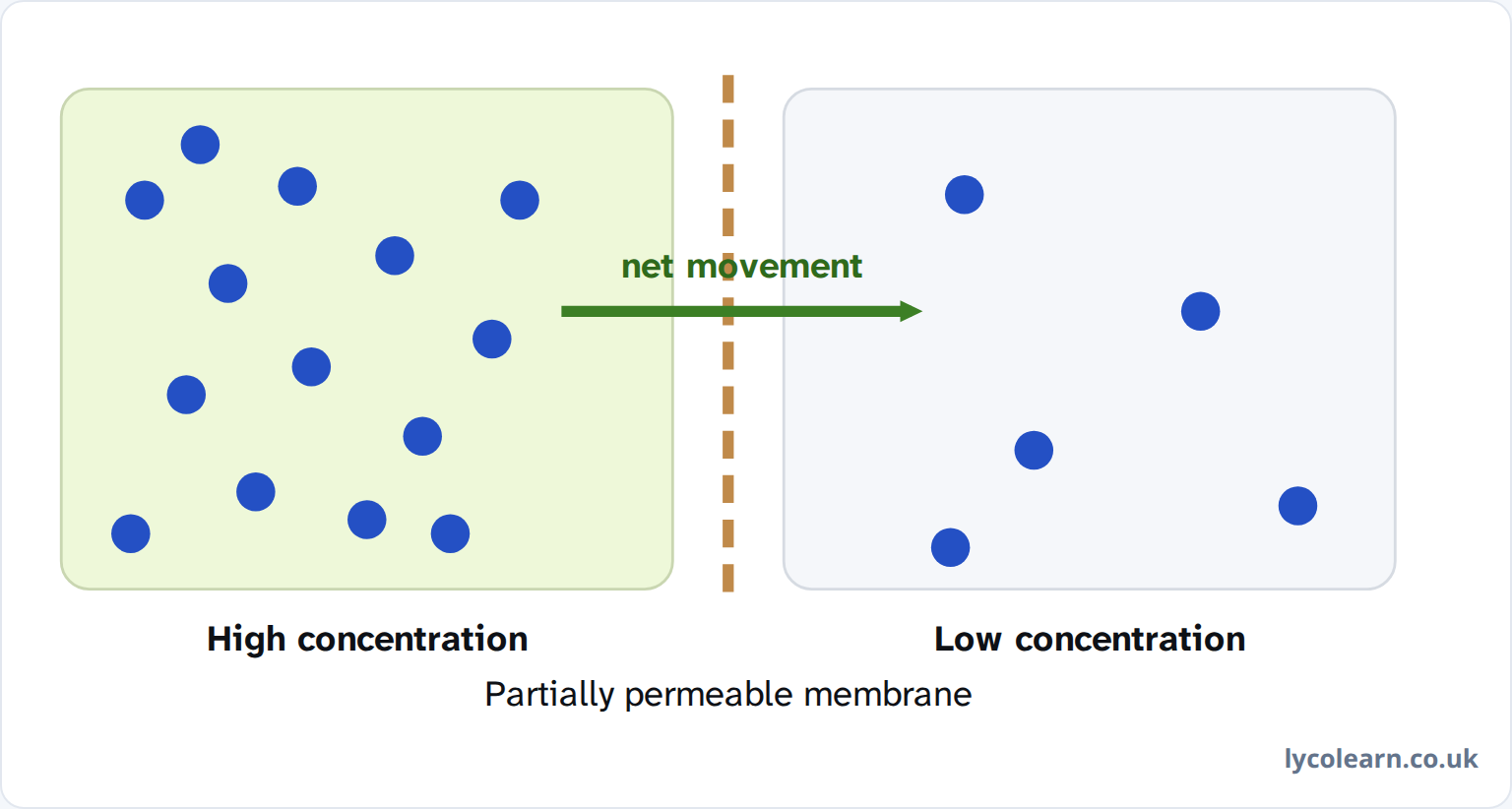
- Diffusion is the spreading out of particles, resulting in a net movement from an area of higher concentration to an area of lower concentration.
- It is passive: it does not need energy from respiration.
- Examples: oxygen and carbon dioxide diffuse in gas exchange; urea diffuses from cells into the blood plasma to be taken to the kidneys.
- The rate of diffusion increases with a bigger concentration gradient, a higher temperature and a larger membrane surface area.
Surface area and exchange surfaces
- Single-celled organisms have a large surface area to volume ratio, so diffusion across their surface meets their needs.
- Larger organisms have a smaller surface area to volume ratio, so they need specialised exchange surfaces and transport systems.
- Good exchange surfaces have a large surface area, a thin membrane (short diffusion path), an efficient blood supply in animals and ventilation for gas exchange.
- Examples: alveoli in the lungs, villi in the small intestine, gills in fish, and roots and leaves in plants.
Osmosis
- Osmosis is the diffusion of water from a dilute solution to a more concentrated solution through a partially permeable membrane.
- If the solution outside a cell is more dilute than inside, water moves in; animal cells may burst, but plant cells become turgid because of the cell wall.
- If the solution outside is more concentrated, water moves out; animal cells shrivel and plant cells become flaccid (and may become plasmolysed).
Required practical: osmosis in plant tissue
- Cut equal cylinders of potato, blot them dry and measure the mass of each.
- Place them in sugar or salt solutions of different concentrations, and one in distilled water, for the same time at the same temperature.
- Blot and reweigh, then calculate percentage change in mass = (change in mass ÷ starting mass) × 100.
- Plot percentage change against concentration; where the line crosses zero, the solution has the same concentration as the potato cells.
Active transport
- Active transport moves substances from a more dilute solution to a more concentrated solution, against a concentration gradient.
- It needs energy from respiration, so cells that do it have many mitochondria.
- Root hair cells use active transport to absorb mineral ions from very dilute solutions in the soil.
- In the gut, active transport absorbs sugar molecules into the blood when the sugar concentration in the gut is lower.
Exam tip
- Use the exact phrases: 'down a concentration gradient', 'partially permeable membrane' and, for active transport, 'against a concentration gradient, using energy from respiration'.
- In osmosis questions, say water moves from a dilute solution to a more concentrated one.
Common mistakes
- Writing 'from high to low concentration' for osmosis without saying it's the concentration of water.
- Saying active transport doesn't need energy.
- Saying plant cells burst in water: the cell wall stops them.
Key terms
- Diffusion
- The net movement of particles from an area of higher concentration to an area of lower concentration.
- Concentration gradient
- The difference in concentration between two areas.
- Osmosis
- The diffusion of water from a dilute solution to a more concentrated solution through a partially permeable membrane.
- Partially permeable membrane
- A membrane that lets small molecules such as water through but not larger ones.
- Active transport
- The movement of substances against a concentration gradient, using energy from respiration.
- Surface area to volume ratio
- The surface area of an object divided by its volume.
- Turgid
- Describes a plant cell that is swollen and firm because it has taken in water.
- Flaccid
- Describes a plant cell that is soft because it has lost water.
- Plasmolysis
- When the cytoplasm of a plant cell pulls away from the cell wall because it has lost a lot of water.
- Alveoli
- Tiny air sacs in the lungs where gas exchange happens.
Quick questions on Diffusion, osmosis and active transport
- What is diffusion?
- The net movement of particles from higher to lower concentration: Diffusion is passive and goes down a concentration gradient.
- Which of these increases the rate of diffusion?
- A larger surface area: More surface area gives more space for particles to cross.
- What does osmosis move?
- Water: Osmosis is the diffusion of water.
- What happens to a plant cell placed in pure water?
- It becomes turgid: Water enters, but the cell wall stops it bursting.
- What happens to a red blood cell placed in a very concentrated salt solution?
- It shrivels as water leaves: Water leaves by osmosis to the more concentrated solution.
- Why does active transport need energy?
- It moves substances against a concentration gradient: Energy from respiration is needed to move substances from dilute to concentrated.
- Which cells use active transport to absorb mineral ions from the soil?
- Root hair cells: Mineral ions in soil are very dilute, so they must be moved in actively.
- Why do cells that carry out active transport have many mitochondria?
- To release energy from respiration: Mitochondria release the energy needed for active transport.
- A potato cylinder goes from 2.0 g to 2.5 g. What is the percentage change in mass?
- +25%: (0.5 ÷ 2.0) × 100 = 25%.
- Why do large organisms need exchange surfaces and transport systems?
- They have a small surface area to volume ratio: Diffusion across the body surface alone would be too slow.
- Which feature helps the alveoli exchange gases quickly?
- Thin walls, one cell thick: Thin walls make the diffusion distance short.
- Which substance diffuses from body cells into the blood plasma to be removed by the kidneys?
- Urea: Urea is a waste product that diffuses into the plasma.
Diffusion, osmosis and active transport: exam-style questions and mark schemes
Which process needs energy from respiration? [1 mark]
Answer: Active transport
Explain why a plant cell placed in pure water does not burst. [2 marks]
- Water enters the cell by osmosis (1)
- The cell wall is strong and stops the cell bursting, so it becomes turgid (1)
A potato cylinder had a mass of 4.0 g. After 30 minutes in a salt solution its mass was 3.2 g. Calculate the percentage change in mass. [2 marks]
- Change in mass = 3.2 − 4.0 = −0.8 g (1)
- (−0.8 ÷ 4.0) × 100 = −20% (1)
Explain how the small intestine is adapted for the efficient absorption of digested food. [4 marks]
- Millions of villi give a very large surface area (1)
- Villi have walls one cell thick, so the diffusion distance is short (1)
- A good blood supply keeps the concentration gradient steep by carrying absorbed food away (1)
- Cells of the villi have many mitochondria to provide energy for active transport of sugars (1)
Which process moves water into a plant root from the soil? [1 mark]
Answer: Osmosis
A cube of agar has sides of 2 cm. Calculate its surface area to volume ratio. [2 marks]
- surface area = 24 (cm²) and volume = 8 (cm³) (1)
- ratio = 3 : 1 (1)
Explain how the small intestine is adapted for absorbing the products of digestion. [4 marks]
- villi (and microvilli) give a large surface area (1)
- walls one cell thick / thin so short diffusion distance (1)
- good blood supply / many capillaries (1)
- which carries absorbed molecules away, maintaining a steep concentration gradient (1)
How to answer them: exam technique and command words.
More on Diffusion, osmosis and active transport
Diffusion, osmosis and active transport: questions and answers
- A potato cylinder goes from 2.0 g to 2.5 g. What is the percentage change in mass?
- +25%. (0.5 ÷ 2.0) × 100 = 25%.
- Why do large organisms need exchange surfaces and transport systems?
- They have a small surface area to volume ratio. Diffusion across the body surface alone would be too slow.
- Which feature helps the alveoli exchange gases quickly?
- Thin walls, one cell thick. Thin walls make the diffusion distance short.
Practise Diffusion, osmosis and active transport: 12 questions