Start here: how plants make their food
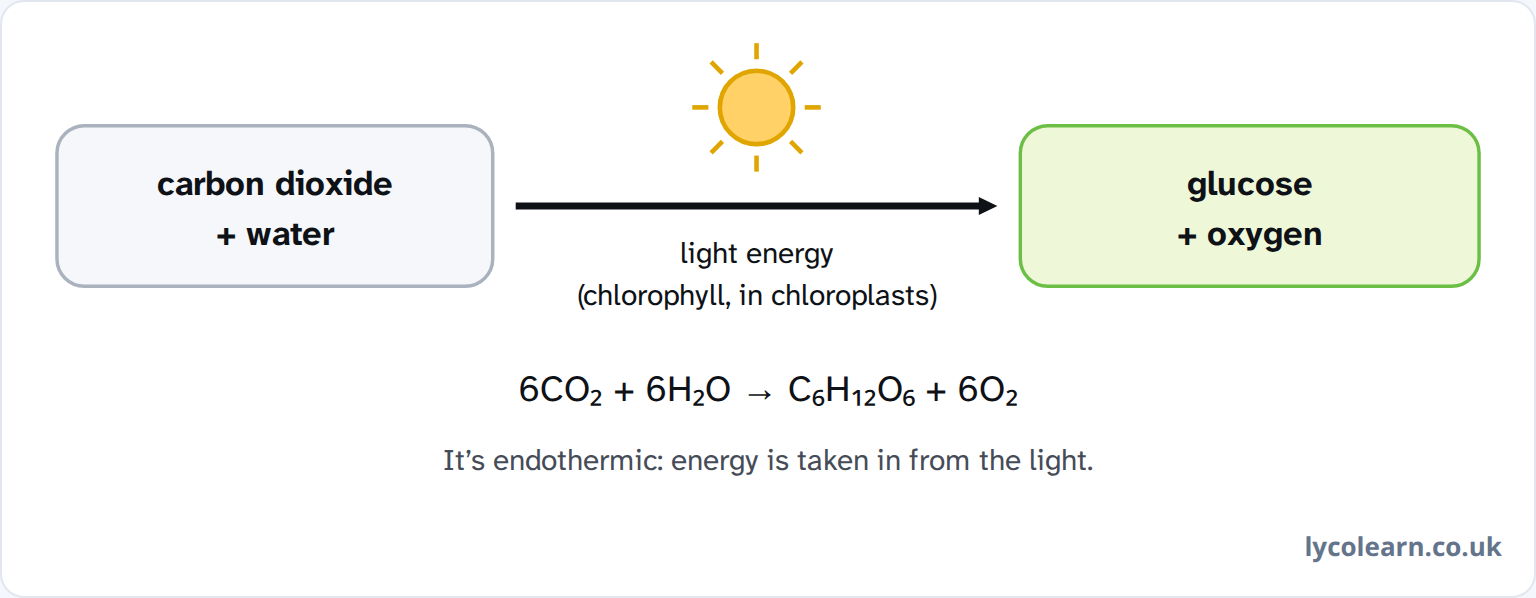
- Plants do not eat: they make their own food, glucose, using light energy from the Sun.
- They take in carbon dioxide from the air and water from the soil, and give out oxygen: carbon dioxide + water → glucose + oxygen.
- It happens in chloroplasts, which contain chlorophyll, the green substance that absorbs light. It is endothermic: energy is taken in, from light.
The photosynthesis reaction
- Photosynthesis happens in chloroplasts. Chlorophyll absorbs light energy, which is used to make glucose.
- Word equation: carbon dioxide + water → glucose + oxygen (light is needed).
- Symbol equation: 6CO₂ + 6H₂O → C₆H₁₂O₆ + 6O₂.
- Photosynthesis is endothermic: energy is transferred from the environment (as light) to the chloroplasts.
Limiting factors
- The rate of photosynthesis is affected by temperature, light intensity, carbon dioxide concentration and the amount of chlorophyll.
- A limiting factor is the factor in shortest supply, which stops the rate increasing.
- Raising light intensity or CO₂ concentration increases the rate until another factor becomes limiting, so the graph levels off.
- Temperature increases the rate up to an optimum; above it, the enzymes involved are denatured and the rate falls.
- (Higher) Light intensity is inversely proportional to the square of the distance from the light source: light intensity ∝ 1 ÷ distance².
Greenhouses
- Farmers use greenhouses to control conditions: heaters for temperature, lamps for light, and paraffin heaters or gas to raise CO₂.
- (Higher) Growers must balance the cost of extra heat, light or CO₂ against the value of the extra crop, so rates are not always kept at the maximum.
Uses of glucose
- Some glucose is used in respiration to release energy.
- Glucose is converted into insoluble starch for storage, and into fats or oils for storage (especially in seeds).
- Glucose is used to make cellulose, which strengthens cell walls.
- Glucose is combined with nitrate ions from the soil to make amino acids, which are used to make proteins.
Required practical: light intensity and photosynthesis
- Put a piece of pondweed in a boiling tube of water with sodium hydrogencarbonate (to supply CO₂).
- Place a lamp at a measured distance and count the bubbles of oxygen (or collect the gas in a gas syringe) in a set time.
- Repeat at different distances. Keep temperature and CO₂ constant; a beaker of water between lamp and tube can absorb heat.
- As the lamp moves closer, light intensity increases and more oxygen is produced, until another factor becomes limiting.
Exam tip
- Learn the word and symbol equations. A limiting factor is whatever is in short supply: on a graph, it's where the line levels off that something else has started to limit the rate.
- In the practical, count bubbles or measure gas at different distances from the lamp, and keep everything else the same.
Common mistakes
- Saying plants only respire at night. They respire all the time.
- Saying photosynthesis 'makes energy'. It stores energy from light in glucose.
Key terms
- Photosynthesis
- The process in which plants use light energy to make glucose from carbon dioxide and water.
- Chlorophyll
- The green pigment in chloroplasts that absorbs light.
- Endothermic
- A reaction that takes in energy from the surroundings.
- Limiting factor
- The factor in shortest supply that stops the rate of a process from increasing.
- Light intensity
- How bright the light is; it falls as distance from the source increases.
- Inverse square law
- Light intensity is proportional to 1 ÷ distance².
- Starch
- An insoluble carbohydrate that plants use to store glucose.
- Cellulose
- A carbohydrate made from glucose that strengthens plant cell walls.
- Nitrate ions
- Mineral ions absorbed from soil and used to make amino acids and proteins.
Quick questions on Photosynthesis
- What are the products of photosynthesis?
- Glucose and oxygen: Carbon dioxide + water → glucose + oxygen.
- Where in a plant cell does photosynthesis happen?
- Chloroplasts: Chloroplasts contain chlorophyll to absorb light.
- Why is photosynthesis described as endothermic?
- Energy is taken in from the environment as light: Light energy is transferred to the chloroplasts.
- What is a limiting factor?
- The factor in shortest supply that stops the rate increasing: Increasing any other factor will not increase the rate.
- Why does the rate of photosynthesis fall at very high temperatures?
- The enzymes are denatured: High temperatures change the shape of the enzymes' active sites.
- A lamp is moved from 10 cm to 20 cm from a plant. What happens to the light intensity?
- It falls to a quarter: Intensity ∝ 1 ÷ d², so doubling the distance gives 1 ÷ 4.
- What is glucose combined with to make amino acids?
- Nitrate ions: Nitrate from the soil provides the nitrogen for amino acids.
- Why do plants store glucose as starch?
- Starch is insoluble: Insoluble starch does not affect water movement by osmosis in cells.
- What is sodium hydrogencarbonate added to the water in the pondweed practical for?
- To supply carbon dioxide: It releases CO₂ so this does not become limiting.
- What gas is in the bubbles given off by pondweed in light?
- Oxygen: Oxygen is a product of photosynthesis.
- How do farmers increase CO₂ in a greenhouse?
- Using paraffin heaters or adding gas: Burning paraffin releases carbon dioxide.
- What is glucose converted into to strengthen cell walls?
- Cellulose: Cellulose fibres make cell walls strong.
- A lamp is moved from 20 cm to 10 cm from a plant. By what factor does the light intensity change?
- It becomes 4 times greater: Light intensity is inversely proportional to the square of the distance. Halving the distance multiplies it by 2² = 4.
- At high light intensity, more light no longer speeds up photosynthesis. What is most likely limiting it now?
- Carbon dioxide concentration or temperature: When one factor stops limiting the rate, another one, such as carbon dioxide or temperature, becomes the limiting factor.
- Why might a grower not heat a greenhouse as warm as possible?
- The extra fuel can cost more than the extra crop is worth: Growers balance the cost of heating, lighting or extra carbon dioxide against the profit from faster growth.
Photosynthesis: exam-style questions and mark schemes
Which is the balanced symbol equation for photosynthesis? [1 mark]
Answer: 6CO₂ + 6H₂O → C₆H₁₂O₆ + 6O₂
Give three ways a plant uses the glucose it makes. [3 marks]
- Respiration (1)
- Making starch, fats or oils for storage (1)
- Making cellulose for cell walls, or amino acids for proteins (1)
A lamp 10 cm from a plant is moved to 5 cm away. How many times greater is the light intensity? Use the inverse square law. [2 marks]
- Intensity ∝ 1 ÷ d², so (10 ÷ 5)² (1)
- = 4 times greater (1)
Describe how you could investigate the effect of light intensity on the rate of photosynthesis using pondweed. [6 marks]
- Place pondweed in a tube of water with sodium hydrogencarbonate (1)
- Put a lamp at a measured distance from the tube (1)
- Count the bubbles, or measure the volume of gas, produced in a fixed time (1)
- Repeat at several different distances (1)
- Keep the temperature constant, for example with a heat shield or water bath (1)
- Repeat and calculate a mean for each distance (1)
Which statement about photosynthesis is correct? [1 mark]
Answer: It is an endothermic reaction
The rate of photosynthesis increases as light intensity increases, then levels off. Explain why the rate levels off. [3 marks]
- light intensity is no longer the limiting factor (1)
- another factor is limiting (1)
- such as carbon dioxide concentration / temperature / amount of chlorophyll (1)
Plan an investigation into the effect of light intensity on the rate of photosynthesis in pondweed. [6 marks]
- pondweed in a tube of water with sodium hydrogencarbonate (to supply CO₂)
- lamp placed at a measured distance (e.g. 10 cm) using a ruler
- leave to acclimatise for a few minutes
- count bubbles / measure volume of gas in a syringe for a fixed time (e.g. 1 minute)
- change the distance (e.g. 10, 20, 30, 40, 50 cm)
- control temperature (use a heat shield / LED / water bath)
- control CO₂ concentration and same piece of pondweed
- darkened room so lamp is the only light source
- repeat and calculate a mean; calculate rate = bubbles ÷ time
How to answer them: exam technique and command words.
More on Photosynthesis
Photosynthesis: questions and answers
- What is sodium hydrogencarbonate added to the water in the pondweed practical for?
- To supply carbon dioxide. It releases CO₂ so this does not become limiting.
- What gas is in the bubbles given off by pondweed in light?
- Oxygen is a product of photosynthesis.
- How do farmers increase CO₂ in a greenhouse?
- Using paraffin heaters or adding gas. Burning paraffin releases carbon dioxide.