Start here: why food has to be digested
- Most of the food you eat is large molecules (starch, proteins and fats) that are too big to pass through the wall of your gut into your blood.
- Digestion breaks them into small, soluble molecules that can be absorbed: starch into sugars, proteins into amino acids, and fats (lipids) into fatty acids and glycerol.
- Enzymes do the breaking down, and each enzyme works on one kind of food molecule.
The digestive system
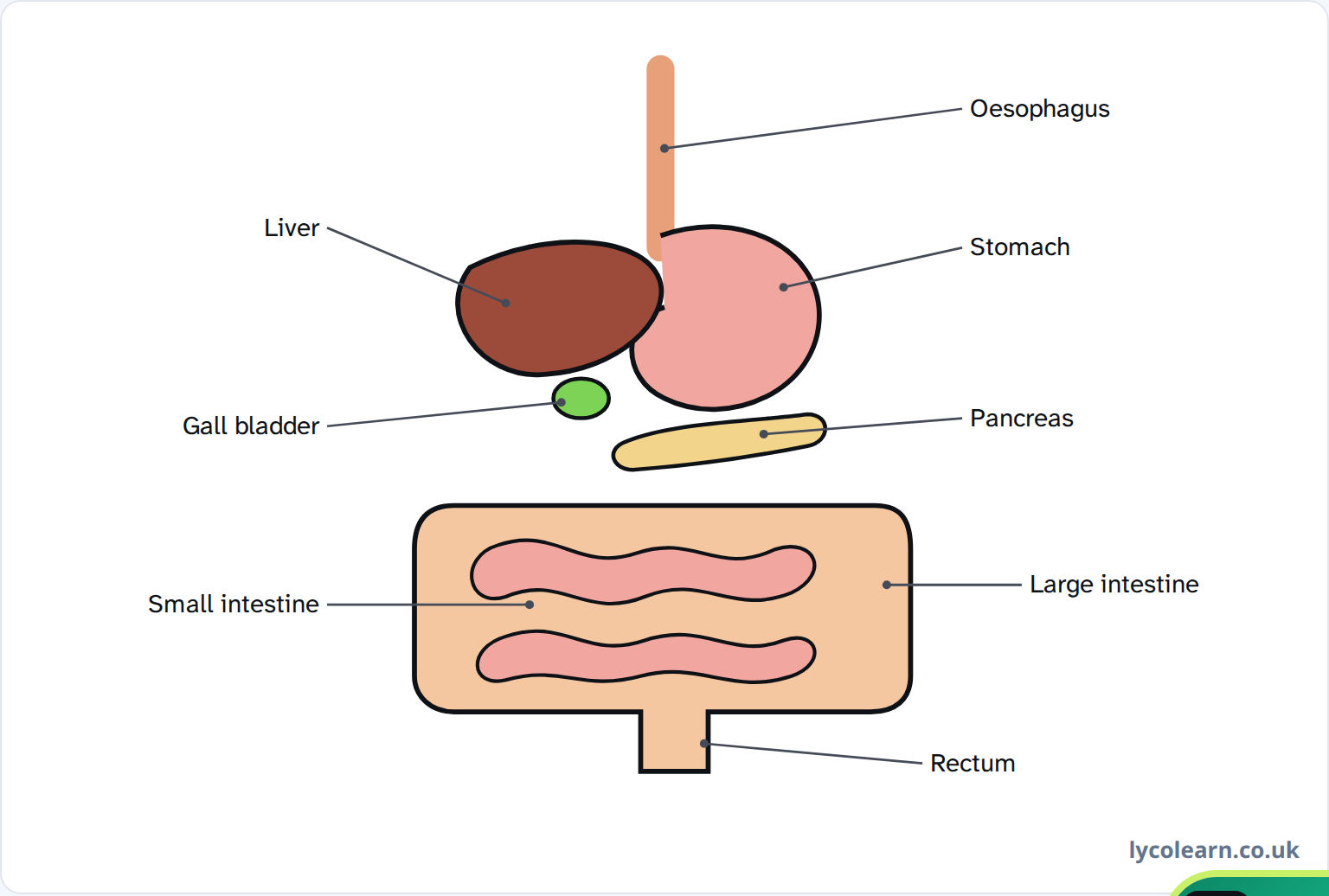
- The digestive system is an organ system that breaks down large, insoluble food molecules into small, soluble ones that can be absorbed into the blood.
- Salivary glands make saliva containing amylase. The stomach churns food and makes hydrochloric acid and protease (pepsin).
- The pancreas makes carbohydrase, protease and lipase, which it releases into the small intestine.
- The small intestine makes more enzymes and absorbs digested food through its villi. The large intestine absorbs water.
- The liver makes bile, which is stored in the gall bladder.
Digestive enzymes
- Carbohydrases break down carbohydrates into simple sugars. Amylase breaks down starch into sugars.
- Proteases break down proteins into amino acids.
- Lipases break down lipids (fats and oils) into fatty acids and glycerol.
- Amylase is made in the salivary glands, pancreas and small intestine; protease in the stomach, pancreas and small intestine; lipase in the pancreas and small intestine.
Bile
- Bile is alkaline, so it neutralises hydrochloric acid from the stomach. This gives the right pH for enzymes in the small intestine.
- Bile emulsifies fat into small droplets, which increases the surface area for lipase to work on.
- Bile is made in the liver and stored in the gall bladder before being released into the small intestine.
Using the products of digestion
- The small, soluble products are absorbed into the blood and used to build new carbohydrates, lipids and proteins.
- Some glucose is used in respiration to release energy.
Required practical: food tests
- Starch: add iodine solution; it turns from orange-brown to blue-black.
- Reducing sugars (such as glucose): add Benedict's solution and heat in a water bath at about 75 °C; it turns from blue to green, yellow or brick red.
- Protein: add Biuret solution; it turns from blue to purple (lilac).
- Lipids: add Sudan III stain and shake; a red-stained oily layer forms on top.
- Grind food with water and filter it first to make a solution to test.
Exam tip
- Learn each enzyme with what it breaks down and what it makes: amylase, starch to sugars; protease, proteins to amino acids; lipase, lipids to glycerol and fatty acids.
- Know each food test and its colour change: Benedict's needs heating, and turns from blue to brick red.
Common mistakes
- Calling bile an enzyme. It emulsifies fats and neutralises stomach acid.
- Mixing up digestion (breaking food down) with absorption (taking it into the blood).
Key terms
- Digestion
- Breaking down large, insoluble food molecules into small, soluble ones.
- Carbohydrase
- An enzyme that breaks down carbohydrates into simple sugars.
- Amylase
- A carbohydrase that breaks down starch into sugars.
- Protease
- An enzyme that breaks down proteins into amino acids.
- Lipase
- An enzyme that breaks down lipids into fatty acids and glycerol.
- Bile
- An alkaline liquid made by the liver that neutralises stomach acid and emulsifies fats.
- Emulsify
- To break fat into small droplets, increasing its surface area.
- Villi
- Finger-like projections in the small intestine that absorb digested food.
- Benedict's test
- A test for reducing sugars: heated with Benedict's solution, a positive result turns green, yellow or brick red.
- Biuret test
- A test for protein: a positive result turns the blue solution purple.
Quick questions on Digestion and the digestive system
- Which enzyme breaks down starch?
- Amylase: Amylase is a carbohydrase.
- What are proteins broken down into?
- Amino acids: Proteases break proteins into amino acids.
- What are lipids broken down into?
- Fatty acids and glycerol: Lipases break down lipids.
- Where is bile made?
- Liver: Bile is made in the liver and stored in the gall bladder.
- How does bile help lipase?
- It emulsifies fat into small droplets, increasing surface area: Emulsification gives lipase more surface to work on.
- Why is bile alkaline?
- To neutralise acid from the stomach: Enzymes in the small intestine work best at a slightly alkaline pH.
- Which organ makes carbohydrase, protease and lipase?
- Pancreas: The pancreas releases all three into the small intestine.
- What is the test for protein?
- Biuret solution turns purple: Biuret turns from blue to purple if protein is present.
- What colour does iodine turn if starch is present?
- Blue-black: Iodine goes from orange-brown to blue-black.
- What must you do in the Benedict's test that you don't in the other food tests?
- Heat the mixture in a water bath: Benedict's solution must be heated to show reducing sugars.
- Where is most digested food absorbed into the blood?
- Small intestine: Villi in the small intestine absorb digested food.
- What does the large intestine mainly absorb?
- Water: The large intestine absorbs water from undigested food.
Digestion and the digestive system: exam-style questions and mark schemes
Which substance is used to test for lipids? [1 mark]
Answer: Sudan III stain
Name the enzymes that digest starch, protein and fat, and give the product of each. [3 marks]
- Amylase breaks starch into sugars (1)
- Protease breaks protein into amino acids (1)
- Lipase breaks fat into fatty acids and glycerol (1)
Describe how you would test a food solution for reducing sugars, and give the positive result. [2 marks]
- Add Benedict's solution and heat in a water bath (about 75 °C) (1)
- A positive result turns from blue to green, yellow or brick red (1)
Explain how bile helps the digestion of fats in the small intestine. [4 marks]
- Bile is made in the liver, stored in the gall bladder and released into the small intestine (1)
- It is alkaline, so it neutralises stomach acid, giving the optimum pH for lipase (1)
- It emulsifies fat into small droplets (1)
- This increases the surface area, so lipase breaks fats into fatty acids and glycerol faster (1)
Name two tissues found in the stomach and give the function of one of them. [2 marks]
- two from: muscular, glandular, epithelial (tissue) (1)
- correct function, e.g. muscular churns food / glandular produces digestive juices (enzymes and acid) / epithelial covers the stomach (lining) (1)
Explain how bile helps the digestion of fats. [4 marks]
- bile emulsifies fat / breaks fat into small droplets (1)
- increasing the surface area (for lipase to act on) (1)
- bile is alkaline and neutralises stomach acid (1)
- giving the (optimum) pH for (lipase) enzymes in the small intestine (1)
Pepsin is a protease found in the stomach. Its optimum pH is about 2. Explain why pepsin stops working when it passes into the small intestine. [4 marks]
- bile neutralises the acid / pH in small intestine is higher (alkaline / neutral) (1)
- pH is far from the optimum of pepsin (1)
- (the bonds holding) the active site changes shape / enzyme denatures (1)
- so protein (substrate) no longer fits / cannot bind to the active site (1)
How to answer them: exam technique and command words.
Digestion and the digestive system: questions and answers
- What colour does iodine turn if starch is present?
- Iodine goes from orange-brown to blue-black.
- What must you do in the Benedict's test that you don't in the other food tests?
- Heat the mixture in a water bath. Benedict's solution must be heated to show reducing sugars.
- Where is most digested food absorbed into the blood?
- Villi in the small intestine absorb digested food.