Start here: what a cell is
- Every living thing is made of cells: tiny units, most too small to see without a microscope. Your body has about 37 trillion of them.
- Each cell has parts, called sub-cellular structures, and each part has one job, a bit like the rooms in a house.
- There are two main types. Eukaryotic cells (animals, plants, fungi) keep their DNA in a nucleus. Prokaryotic cells (bacteria) are much smaller and have no nucleus.
- Learn each part and its job first, then which cells have which parts: that is where most of the marks are.
Eukaryotic and prokaryotic cells
- Animal and plant cells are eukaryotic: their genetic material is enclosed in a nucleus.
- Bacterial cells are prokaryotic: they are much smaller and their DNA is a single loop in the cytoplasm, not in a nucleus.
- Bacteria may also have small rings of DNA called plasmids.
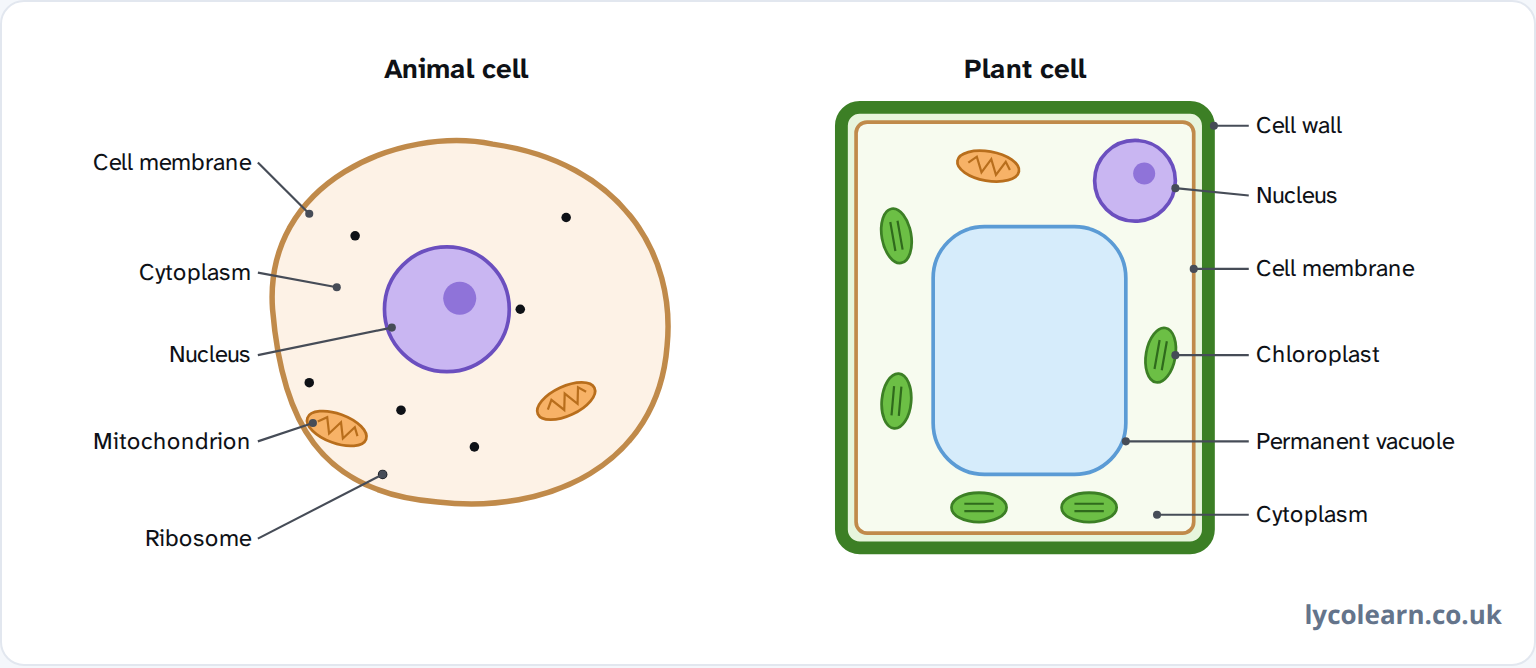
Parts of an animal cell
- Nucleus: contains the genetic material that controls the cell's activities.
- Cytoplasm: a gel where most chemical reactions happen, controlled by enzymes.
- Cell membrane: controls what enters and leaves the cell.
- Mitochondria: where aerobic respiration happens, releasing energy.
- Ribosomes: where proteins are made (protein synthesis).
Extra parts in plant cells
- Cell wall: made of cellulose; strengthens and supports the cell.
- Chloroplasts: contain chlorophyll, which absorbs light for photosynthesis.
- Permanent vacuole: filled with cell sap; keeps the cell rigid.
Specialised cells
- Sperm cells have a tail to swim and lots of mitochondria to release energy.
- Nerve cells are long, with branched endings, to carry electrical impulses around the body.
- Muscle cells contain protein fibres that contract, and many mitochondria.
- Root hair cells have a large surface area to absorb water and mineral ions.
- Xylem cells form hollow tubes that carry water; phloem cells carry dissolved sugars.
Size and scale
- Cells are measured in micrometres (µm): 1 mm = 1000 µm.
- Bacteria are about 1–10 µm long; animal cells are about 10–100 µm.
- Magnification = image size ÷ actual size. Use the same units for both.
Culturing microorganisms
- Bacteria multiply by simple cell division called binary fission, as often as once every 20 minutes if they have enough nutrients and a suitable temperature.
- Bacteria are grown in a nutrient broth or as colonies on an agar gel plate. Uncontaminated cultures are needed to study the effect of disinfectants and antibiotics.
- Aseptic technique: sterilise Petri dishes and culture media before use, and pass inoculating loops through a flame. Tape the lid on lightly (not sealed all round) and store the dish upside down.
- In school laboratories, cultures are incubated at no more than 25 °C, which reduces the chance of growing pathogens that could harm humans.
- Number of bacteria = starting number × 2ⁿ, where n is the number of divisions.
- Required practical: put paper discs soaked in different antibiotics or antiseptics on an agar plate spread with bacteria. The bigger the clear zone of inhibition around a disc, the better it stops the bacteria. Area of a clear zone = πr².
Exam tip
- Learn each part with its job: marks usually come from linking them, such as 'mitochondria release energy through aerobic respiration'.
- When comparing plant and animal cells, always mention the cell wall, chloroplasts and permanent vacuole.
Common mistakes
- Saying bacteria have a nucleus. Their DNA is loose in the cytoplasm.
- Saying mitochondria 'make' energy. Energy is released, never made.
- Saying plant cells don't have mitochondria. They do.
Key terms
- Eukaryotic cell
- A cell whose genetic material is enclosed in a nucleus, e.g. animal and plant cells.
- Prokaryotic cell
- A cell with no nucleus; its DNA is a single loop in the cytoplasm, e.g. bacteria.
- Nucleus
- Contains genetic material that controls the activities of the cell.
- Mitochondria
- Where aerobic respiration happens, releasing energy for the cell.
- Ribosome
- The site of protein synthesis.
- Chloroplast
- Contains chlorophyll to absorb light for photosynthesis.
- Cell wall
- Made of cellulose in plants; strengthens and supports the cell.
- Plasmid
- A small ring of DNA found in bacterial cells.
- Specialised cell
- A cell with features that help it carry out a particular job.
- Magnification
- How many times bigger an image is than the real object: image size ÷ actual size.
- Binary fission
- The simple cell division by which bacteria reproduce.
- Zone of inhibition
- The clear area around an antibiotic or antiseptic where bacteria have not grown.
Quick questions on Cell structure
- Where does aerobic respiration happen in a cell?
- Mitochondria: Mitochondria are where aerobic respiration releases energy.
- What is the job of ribosomes?
- Making proteins: Ribosomes are the site of protein synthesis.
- Which structure is found in plant cells but not animal cells?
- Cell wall: Plant cells have a cellulose cell wall; animal cells do not.
- What is a plant cell wall made of?
- Cellulose: Plant cell walls are made of cellulose.
- Which type of cell has its DNA in a single loop, not in a nucleus?
- Prokaryotic cell: Prokaryotic cells such as bacteria have no nucleus.
- What are plasmids?
- Small rings of DNA in bacteria: Plasmids are extra small rings of DNA found in bacteria.
- What does the cell membrane do?
- Controls what enters and leaves the cell: The membrane controls the movement of substances in and out.
- What do chloroplasts contain to absorb light?
- Chlorophyll: Chlorophyll is the green pigment that absorbs light.
- How many micrometres are in 1 millimetre?
- 1000: 1 mm = 1000 µm.
- Why do sperm cells contain lots of mitochondria?
- To release energy for swimming: Mitochondria release the energy the tail needs to swim.
- Which plant cell has a large surface area to absorb water?
- Root hair cell: Root hair cells have long projections that increase surface area.
- Magnification = image size ÷ ...
- Actual size: Magnification = image size ÷ actual size.
- How do bacteria multiply?
- By binary fission: Binary fission is simple cell division; it can happen every 20 minutes.
- Why are cultures in school incubated at no more than 25 °C?
- To reduce the chance of growing human pathogens: Pathogens that harm humans grow best at about body temperature, 37 °C.
- Why is an inoculating loop passed through a flame?
- To kill unwanted microorganisms on it: Sterilising the loop stops the culture being contaminated.
- A clear zone around an antibiotic disc has a radius of 5 mm. What is its area?
- 78.5 mm²: Area = πr² = 3.14 × 5² = 78.5 mm².
Cell structure: exam-style questions and mark schemes
Which of these is found in a bacterial cell? [1 mark]
Answer: Plasmid
Name the part of a cell where proteins are made. [1 mark]
- ribosome(s)
A cell is 0.02 mm long. What is its length in micrometres (µm)? [2 marks]
- 0.02 × 1000 (1)
- = 20 µm (1)
Compare the structure of a plant cell with the structure of a bacterial cell. [4 marks]
- Both have a cell membrane, cytoplasm and ribosomes (1)
- Both have a cell wall, but the plant cell wall is made of cellulose (1)
- The plant cell has a nucleus; bacterial DNA is a single loop, not in a nucleus (1)
- Plant cells have chloroplasts, a permanent vacuole and mitochondria; bacteria may have plasmids (1)
Describe how you could investigate the effect of different antibiotics on the growth of bacteria. [4 marks]
- Spread bacteria evenly on an agar plate using aseptic technique, such as a sterilised spreader (1)
- Place paper discs soaked in different antibiotics, and one soaked in sterile water as a control, on the agar (1)
- Tape the lid on lightly and incubate at 25 °C for about 48 hours (1)
- Measure the diameter of the clear zone around each disc and calculate its area using πr² (1)
Which structure is found in a bacterial cell but not in a plant cell? [1 mark]
Answer: Plasmid
Root hair cells absorb water and mineral ions from the soil. Explain how a root hair cell is adapted to its function. [4 marks]
- (long) root hair / extension gives a large surface area (1)
- for (more/faster) absorption of water (by osmosis) (1)
- many mitochondria (1)
- to release energy for active transport (of mineral ions) (1)
A student investigated the effect of three antiseptics, X, Y and Z, on the growth of bacteria. Describe a method the student could use. Include how they would make the investigation valid and safe. [6 marks]
- sterilise Petri dish and agar (autoclave) before use
- sterilise inoculating loop by passing through a flame
- spread bacteria evenly over the agar (lawn)
- soak paper discs in each antiseptic
- include a control disc soaked in sterile water
- place discs on agar with sterile forceps, spaced apart
- tape lid in place but do not seal fully; store upside down
- incubate at 25 °C (for 48 hours)
- measure the diameter of the zone of inhibition and calculate the area (πr²)
- control variables: same bacteria, same disc size, same volume/concentration of antiseptic, same time and temperature
- repeat and calculate a mean
How to answer them: exam technique and command words.
More on Cell structure
Cell structure: questions and answers
- How many micrometres are in 1 millimetre?
- 1 mm = 1000 µm.
- Why do sperm cells contain lots of mitochondria?
- To release energy for swimming. Mitochondria release the energy the tail needs to swim.
- Which plant cell has a large surface area to absorb water?
- Root hair cells have long projections that increase surface area.